
AI bedtime stories and personalized books: what to check first
Before you upload your child's photo to an AI bedtime story app or a personalized book, check where the photos go, who sees them, and how it reads at bedtime.
In this post
- Three kinds of personalized books
- 1. Where the photos go, and whether you can delete them
- 2. What COPPA covers, and what it doesn’t
- 3. Whether your child still looks like your child on page six
- 4. Whether it’s labeled as AI, and whether you can check it
- 5. How it behaves at bedtime
- 6. Whether the lesson is shown or told
- 7. Price and renewals
- How Once Upon Us answers this list
A good AI bedtime story app or personalized book keeps your child’s photos private and deletable, draws your child the same way on every page, says plainly that AI made it, and reads well in a dim room at the end of a long day. Most of the difference between products is in those four things, and you can check all of them before you upload a single photo.
This is the list we’d want a friend to hand us. It covers the three kinds of personalized books you’ll find, then the questions worth asking about each.
Three kinds of personalized books
Printed personalized books
You type your child’s name and build an avatar: hair, skin tone, sometimes glasses or freckles. The story is a template with your child’s name dropped in, printed and mailed. A few use a photo to shape the avatar.
AI story apps
You pick a theme or type a prompt (“a dragon who is scared of the dark”) and the app writes a story, often with generic art and a read-aloud voice. Your child’s name may be in it. Their face usually isn’t.
AI picture books from photos
You upload photos and the app draws your child into an illustrated story. Some add a lesson, some read aloud, some can be printed.
The more personal the input, the more the rest of this list matters. A name is one thing. A folder of photos of your two-year-old is another.
1. Where the photos go, and whether you can delete them
Photos of children are about as personal as data gets. A survey by Ireland’s Data Protection Commission and France’s CNIL found that three in four parents had shared content about their children online in the past year, and that most of them worried the images could be misused by strangers (Irish Examiner). Leaks do happen. In February 2026, an AI image app turned out to have left its cloud storage open with no authentication, and 1.5 million photos its users had uploaded were exposed (PetaPixel).
Before you upload, find these answers in the privacy policy or FAQ:
- Who can see the photos and the finished books. It should be your family and no one else, with no public gallery or “featured stories” unless you opt in.
- Which AI companies receive them. Small apps rarely run their own models, so your photos usually travel to a third-party AI provider. A trustworthy app names them.
- Whether anything is used to train AI. You want a plain “no” that covers both the app and the providers it sends photos to.
- What you can delete yourself: one photo, one child, one book, or everything at once, from inside the app and without emailing support.
- How long source photos are kept. Some services delete them once the book or the character drawing is made. Keeping less is safer.
2. What COPPA covers, and what it doesn’t
It’s easy to assume the US children’s privacy law protects anything involving your kids. It’s narrower than that. The FTC explains that COPPA “only covers information collected online from children” under 13, and “does not cover information collected from adults that pertain to children” (FTC COPPA FAQ). Photos you upload as a parent fall in the second group. For those, the app’s own promises are what you’re relying on, so read them.
COPPA does come into play when a service collects information from your child directly, and that includes their voice. If an app listens for your toddler saying “again!”, the FTC’s position is that it can use the recording as a stand-in for typed words only if it deletes it right after (FTC policy statement on audio). Ask any voice-controlled story app whether it keeps recordings. The answer should be no.
For services that are covered, the FTC’s guide for parents says you should get a plain-language notice before anything is collected, and you can review your child’s information, withdraw consent and have it deleted at any time (FTC consumer advice). This is a summary for parents, not legal advice.
3. Whether your child still looks like your child on page six
A picture book about your kid only works if your kid recognizes themselves on every page. This is where personalized books most often fall short. In public reviews of photo-based books, parents describe a child who looks pasted into the scene or changes from page to page, and reviews of avatar-based books mention skin tones and hairstyles that came out wrong.
What to check before paying:
- Look at a full sample book, or preview every page of yours, not just the cover.
- Find the same child on several pages and in different scenes. Faces, hair texture, eye color and skin tone should hold steady.
- If you have two kids, make sure they don’t blur into each other.
- Ask how the service keeps a child consistent. “Our AI is very good” isn’t an answer.
Here’s what consistency looks like when it works. Pip and Wren are made up, drawn from a written description, and this short story switches art styles between pages on purpose.
An example story
Pip, Wren and the Blackberry Lane
Hedgerow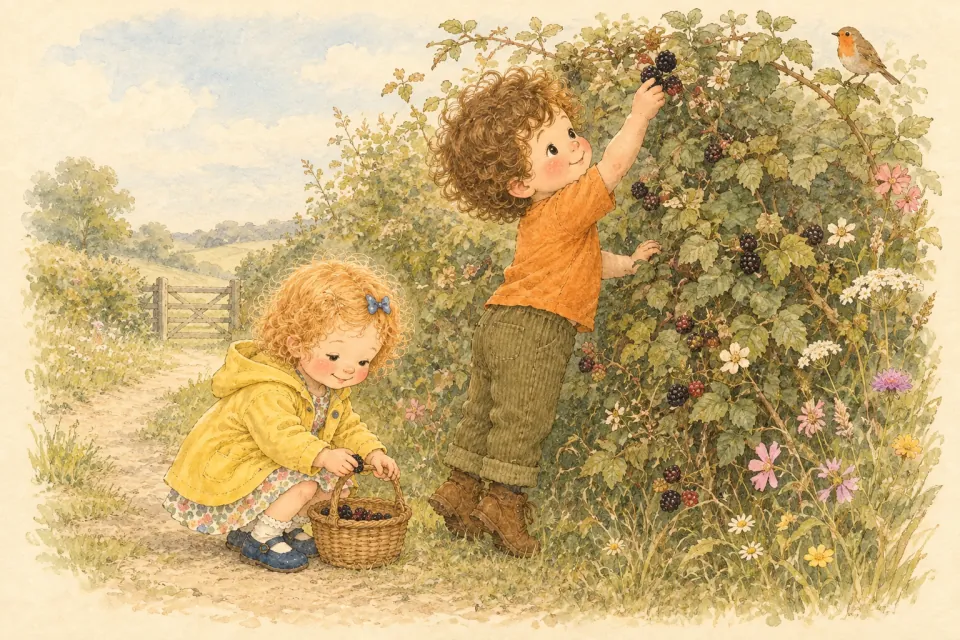
Down the lane, the blackberries were ready. Pip picked the high ones. Wren picked the low ones. “One for the basket,” said Pip. “One for me,” said Wren.
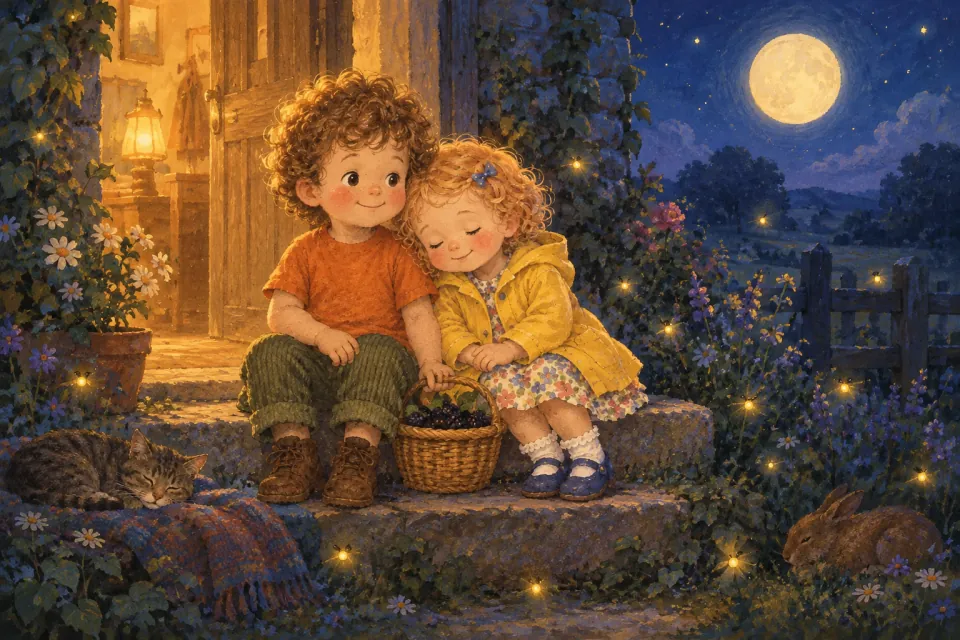
When the sky turned blue-black, the basket was full and so were two tummies. The fireflies came out to see. “Goodnight, berries,” whispered Wren.
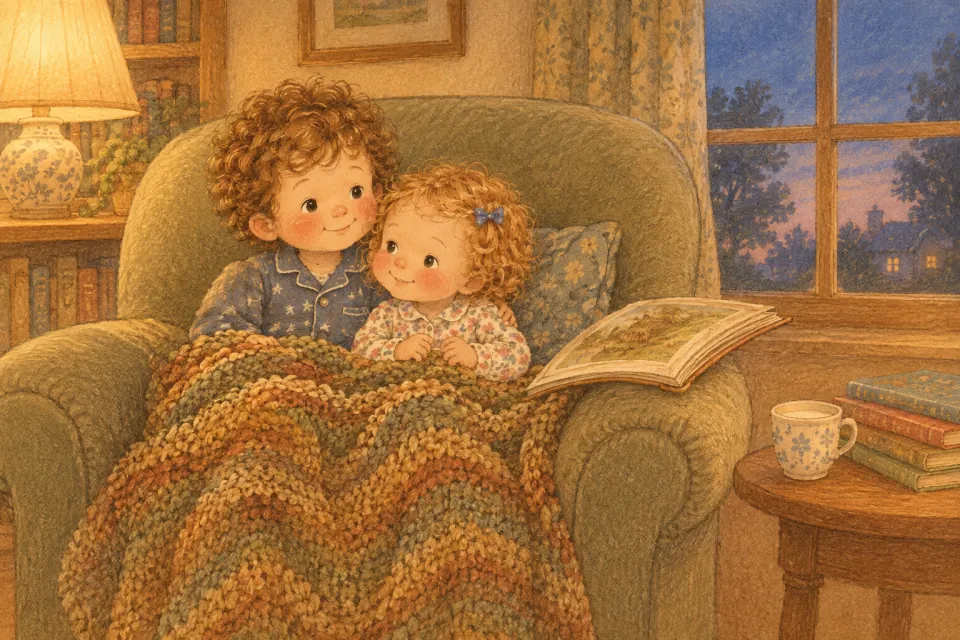
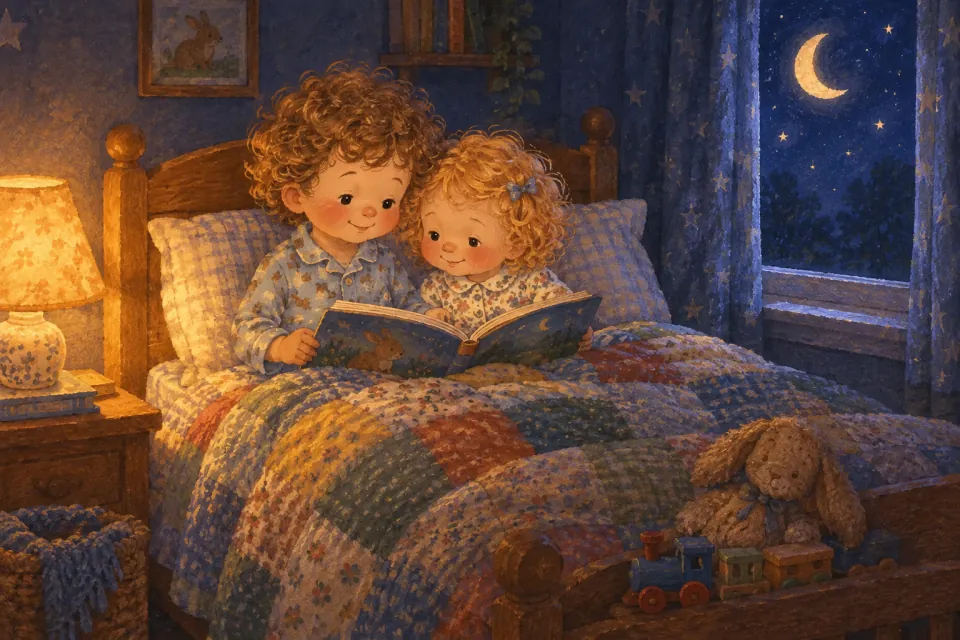
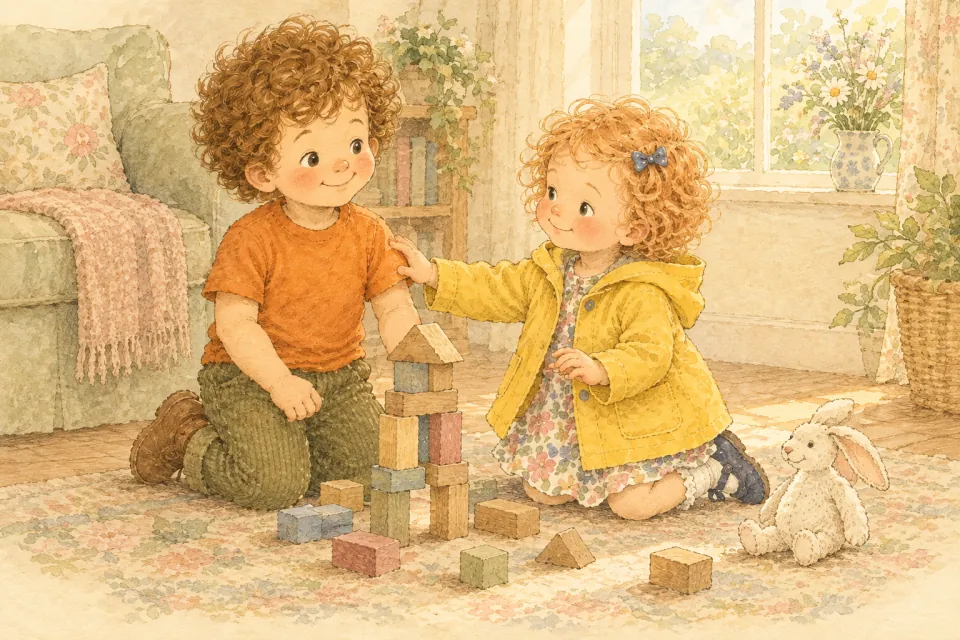
The first page is Hedgerow, the second Moonlit. Same curls, same cheeks, same orange shirt and yellow raincoat. That’s the standard to hold any product to, whatever style it paints in. You can see more styles on the landing page.
4. Whether it’s labeled as AI, and whether you can check it
Researchers at NC State asked parents and children about AI illustrations in children’s stories. Parents “preferred a clear notification on the cover of the story making clear whether AI had been used”, worried about pictures that could show unsafe behavior, and children were quicker than adults to notice when a picture’s emotion didn’t match the words (NC State).
Guardrails also leak. When Common Sense Media tested AI toy companions, a different product but the same kind of technology, 27% of the toys’ responses were inappropriate for kids (Common Sense Media).
So look for:
- An AI label on the book itself, not only in the terms of service.
- A way to read or flip through every book before your child sees it.
- A way to fix a single page or picture without starting over.
- Written rules for what pictures may show. For toddlers that means children fully dressed, no bath or bathroom scenes, nothing frightening.
5. How it behaves at bedtime
The American Academy of Pediatrics suggests turning off all screens at least an hour before bedtime and keeping them out of children’s bedrooms (HealthyChildren.org). Its “Brush, Book, Bed” routine is simple: brush teeth, read a favorite book or two together, and go to bed at a regular time (HealthyChildren.org). The AAP also notes that toddlers learn more from media when an adult watches with them, asks questions and helps connect the story to the child’s own life (AAP).
Any story app used at bedtime runs up against that advice. We think the right way to use one is side by side, the way you’d share a picture book, and to print the stories they ask for most. On the app itself, check for:
- Narration at a slow, calm pace, with pages that turn on their own so nobody has to hold the phone.
- A screen that gets dimmer and warmer as the story goes on, not brighter.
- A nightly limit, so the last story is the last story.
- No ads, no autoplay into the next thing, and no purchases inside the book.
If you’re building the rest of the evening, our toddler bedtime routine guide goes step by step, and there are short bedtime stories for 2- and 3-year-olds you can read tonight.
6. Whether the lesson is shown or told
Many personalized books promise a lesson. The good ones put it in the plot. A character feels the urge to grab, stops, and pats gently instead, and something nice happens because of it. The weak ones add a moral paragraph at the end.
One study gives a hint about why the “who” matters too. Researchers at the University of Toronto read 4- to 6-year-olds a story about sharing. Children who heard the version with human characters shared more stickers afterward. Children who heard the same story told with animal characters shared less (Neuroscience News summary; Larsen, Lee and Ganea, Developmental Science). That study didn’t test personalized books, so don’t lean on it too hard. It does suggest kids take more from characters they see as like themselves.
Check whether you can choose the lesson you’re working on this month, and read a sample to see whether it’s acted out or tacked on. Our posts on gentle hands and sharing show what the shown version looks like.
7. Price and renewals
Before you start a free trial, find out whether it turns into a paid plan on its own, when it renews, and what counts as one book. Re-reading a book you already made shouldn’t cost anything. If you subscribe through an iPhone app, Apple’s steps to cancel a subscription are short. Set a reminder the day you sign up.
How Once Upon Us answers this list
We’re building Once Upon Us, so here is where it stands, briefly.
Photos, character drawings, pages and narration sit in private storage and are only shown to your signed-in family. We don’t train AI on your family, and the AI services we use don’t train on what we send them through their business APIs. We name them: Claude, by Anthropic, writes the stories, and OpenAI’s models paint and narrate them. Voice is off until you switch it on, and the audio is never recorded or kept. You can delete any photo, person or story, and “Delete everything” wipes it all at once.
Each child is drawn once per art style as a character sheet, and every page is painted with those sheets in hand. Pictures are asked to be safe for a two-year-old: fully dressed, no bath or bathroom scenes, nothing scary. We say plainly that the stories are written, illustrated and narrated with AI. The books read aloud, turn their own pages and dim toward goodnight.
It isn’t for sale yet. We’re opening early access a few families at a time, pricing isn’t final, and it isn’t on the App Store yet. More on privacy and bedtime mode.
Questions parents ask
Are AI bedtime story apps safe for toddlers?
It depends on the app. Look for private storage, a plain promise that your photos aren’t used to train AI, a clear AI label, a way to preview every book before your child sees it, and a button that deletes everything. Then read it together instead of handing over the screen.
Does COPPA protect the photos I upload of my child?
Not directly. The FTC says COPPA covers information collected online from children under 13, not information adults provide about their children. For photos you upload, the app’s own privacy policy is what protects them. See the FTC’s COPPA FAQ.
Can a personalized book really look like my child?
It depends on how it’s made. Avatar builders get hair and skin tone roughly right but rarely the face. Photo-based books can capture a face but may drift from page to page. Ask to see several pages of the same child, in more than one scene, before you pay.
Is it okay to use a screen for bedtime stories?
The American Academy of Pediatrics suggests turning screens off at least an hour before bed and keeping them out of bedrooms. If you use a story app, keep it short and calm, read it with your child, and let a printed book or your own voice close the night.
Sources
- Complying with COPPA: Frequently Asked Questions, Federal Trade Commission
- Enforcement Policy Statement Regarding the Applicability of the COPPA Rule to the Collection and Use of Voice Recordings, Federal Trade Commission
- Protecting Your Child’s Privacy Online, FTC Consumer Advice
- Three in four parents share children’s photos online despite privacy fears, DPC survey finds, Irish Examiner
- AI Image App Leaks 1.5 Million User-Generated Photos, PetaPixel
- How Parents and Kids Really Feel About AI-Generated Images in Children’s Books, NC State University
- Common Sense Media Warns Against AI Toy Companions After Research Reveals Safety Risks, Common Sense Media
- Healthy Sleep Habits: How Many Hours Does Your Child Need?, HealthyChildren.org (American Academy of Pediatrics)
- Brush, Book, Bed: How to Structure Your Child’s Nighttime Routine, HealthyChildren.org (American Academy of Pediatrics)
- Preferred Method of Screen Time/Selecting Best Shows/Games for Toddlers, American Academy of Pediatrics
- Do storybooks with anthropomorphized animal characters promote prosocial behaviors in young children?, Larsen, Lee and Ganea, Developmental Science
- Human Characters, Not Animals, Teach Children Best Moral Lessons, Neuroscience News
- Cancel a subscription from Apple, Apple Support