
AI bedtime story prompts: six little adventures to make your own
Copy six AI bedtime story prompts for sharing, siblings, bravery, counting, and little days. See a narrated book, then adapt the words for your own child.
In this post
- See a written moment become a story
- The reusable prompt
- 1. The little day that becomes an adventure
- 2. A sharing story with a small problem
- 3. Siblings who each bring something different
- 4. A brave moment without a big rescue
- 5. A counting train that knows where it is going
- 6. A familiar evening, with one imaginary guest
- Read the draft before you read it together
- Make a book from a prompt
Useful AI bedtime story prompts give a story somewhere specific to begin and somewhere gentle to finish. “Write a story for a child” leaves almost everything undecided. “Two siblings take a tiny train past three sleepy sheep and arrive home” gives you a picture, an action, and an ending.
Below are six prompts you can copy and adapt, plus a reusable template and a complete narrated book to explore. They are creative starting points for a parent or caregiver to use and review. You can also use them to make up a story in your own words, without an AI tool.
See a written moment become a story
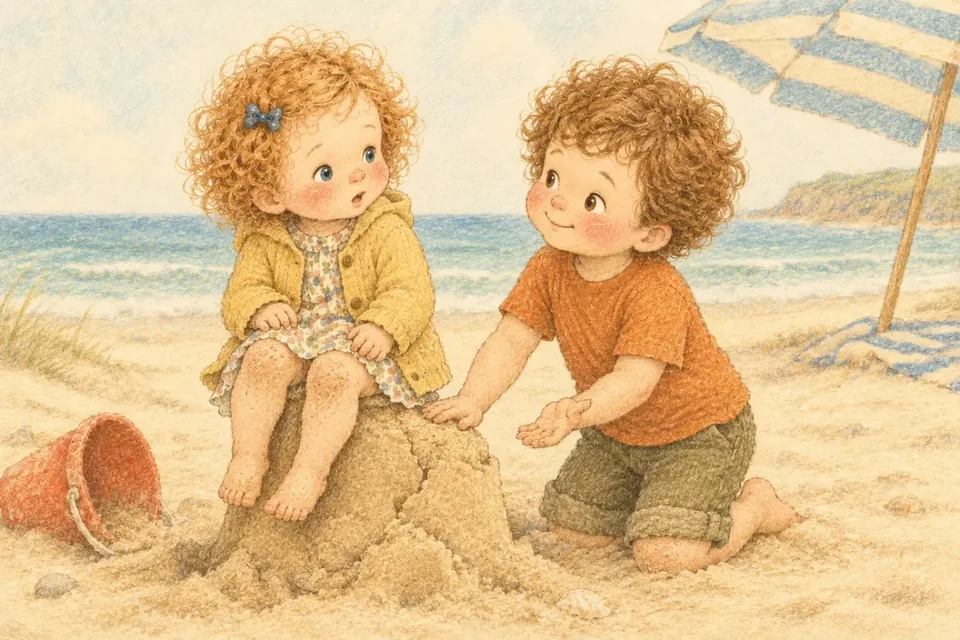
This short film follows a written beach-day idea into an illustrated page with narration. It shows one way to start a Once Upon Us book; invited families can also add photos. The sample family is fictional.
A written beach-day moment leads to actual sample artwork and a narrated page.
Edited introduction. Actual sample artwork; fictional family. New books take a few minutes to make.
Film description & transcript
A written beach-day moment leads to actual sample artwork and a narrated page. Narration: “Scoop, scoop! Pat, pat! Pip and Wren built a sandcastle by the sea. One tower. Two towers. Three!”
A good starting detail can be very small: a yellow bucket, a cardboard box, or the word your child used for a shell. You don’t need a long character profile to make a story feel personal. Keep the first attempt simple enough that you can tell whether the result kept the detail you cared about.
The reusable prompt
Copy this paragraph and change the words in brackets:
Write a short read-aloud story for a child who enjoys [interest]. The main character is [nickname or fictional name], and one familiar detail is [toy, place, or small moment]. The adventure is [one event]. Use simple sentences, a repeated phrase, and a warm tone. Aim for about [word count] words. Finish with [specific quiet ending]. Avoid [anything this child dislikes]. Do not add a moral or promise that the story will change behavior. Give me a draft to review.
For a first draft, you might choose 150–250 words. That is a manageable writing target, not a rule about how much a child should listen to. Shorten the result if it rambles. If you want a picture-book layout, ask for six short page sections and one visual scene per page; the actual page count a product supports may differ.
The AAP’s guide to sharing books at ages two and three welcomes children talking about pictures and retelling familiar stories. Leave room for those moments. A draft doesn’t need a question after every sentence or a test at the end.
1. The little day that becomes an adventure
Write a short read-aloud story about two siblings who find a smooth shell on a walk by the sea. One carries a yellow bucket. They imagine the shell is a tiny house for a very polite crab. Keep the adventure close to the beach, with no danger or separation from their grown-up. Repeat “A little room for you.” End with the shell back on the sand and the children heading home together. Aim for 200 words, with simple sentences and no closing lesson.
Make it yours: Swap the shell for the actual discovery: a leaf, pebble, feather, or interesting stick. Keep the real event separate from the imagined part. “Let’s pretend the shell was a house” is a clearer invitation than telling a child an invented scene really happened.
For a photo-based keepsake version, follow our six-picture family storybook recipe. For an illustrated version, your written description can be enough.
2. A sharing story with a small problem
Write a warm story about Pip and Wren making a pretend soup in a garden. There is one wooden spoon, and both want to stir. Let each child say what they want. A grown-up helps them find a way to take turns that they both understand. Include a funny pretend ingredient and repeat “Stir, stir, little soup.” End with the spoon resting beside two empty bowls. Aim for 180 words. Do not call either child selfish, and do not end with a speech about sharing.
Make it yours: Use the object at the center of your child’s play, but avoid replaying an upsetting moment as a public judgment. A fictional spoon can give you a fresh story. This is a creative example, not a promise that one reading will resolve a conflict.
If you’re looking for practical ideas beyond a story, our guide to helping toddlers share covers that separately. The prompt’s job is to create something you can read together.
3. Siblings who each bring something different
Write a short story about two siblings building a blanket fort with their grown-up nearby. One likes arranging cushions; the other likes choosing which toy comes inside. A cushion slips, and they find a new place for it together. Give both characters a useful idea without making the older child responsible for the younger one. Repeat “There’s a place for that.” Finish with both children looking at a picture book in the fort. Use 200 words and a cozy, playful tone.
Make it yours: Choose two real interests instead of assigning personalities by age. The younger child can be the careful planner; the older one can be the enthusiastic collector. If your family is preparing for a new baby, try our complete new-baby read-aloud story and its family-book outline.
The original studio film below imagines a blanket fort becoming a woodland world. It is creative inspiration, not a demonstration of the output this prompt will produce.
A blanket fort opens into a lantern-lit forest.
An imaginative campaign film. Once Upon Us makes illustrated, narrated picture books.
Film description & transcript
A blanket fort opens into a lantern-lit forest. Instrumental music; no spoken narration.
4. A brave moment without a big rescue
Write a gentle story about a child who wants to join a pretend picnic with two friendly woodland animals but isn’t sure what to say. Let the child watch first, stay near their grown-up, and choose whether to say hello. The animals make room without rushing. Include a little red cup and the phrase “I can take my time.” End with the child choosing a comfortable place for the cup. Aim for 180 words. No danger, villains, forced hugs, or claim that all worries disappear.
Make it yours: Change the picnic to a familiar setting. Keep the choice real in the story; a character can take a small step without being pushed into a triumphant ending. Read the draft for any line that makes a cautious child sound like a problem to fix.
For a ready-made adventure with a similar theme, visit our story collection and choose the bravery story. Your own version can be much smaller and still be worth reading.
5. A counting train that knows where it is going
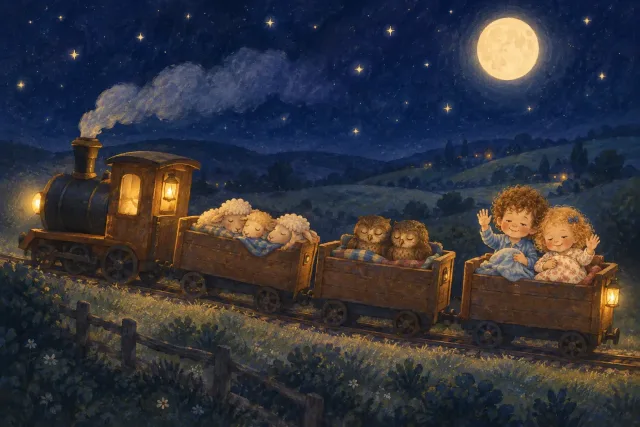
Write a sleepy counting story about a little train. It passes three sheep, two owls, and one glowing window. The passengers wave goodnight; nobody gets lost or left behind. Repeat “Closer to home.” Use fewer words on the last two pages than on the first two. Finish with the train parked and the child at home with a familiar grown-up. Aim for 150 words. No cliffhanger, new quest, or question about what happens next.
Make it yours: Count things your child enjoys: ducks, stars, toy trucks. Check that the numbers and pictures agree if you generate illustrations. One accidental extra sheep can be an entertaining conversation, but it shouldn’t quietly change the counting pattern you intended.
This independently created sample book uses a related counting-train idea. It isn’t a guaranteed output of the prompt above. You can read every page and hear the narration without an account.
The whole story · Read & listen
The Night Train
Three sleepy sheep, two little owls, and one last stop: bed.
The end. Their next adventure could star your family. Join free early access →
Free to explore. No sign-in. Fictional children; AI-made words, pictures and narration. Read together at your own pace.
Read the complete story as text
Chuff… chuff… chuff. Here comes the night train, slow and low over the hills.
At the first stop, three sleepy sheep climbed aboard. Baa, baa, yawn. They snuggled under a blanket.
At the next stop, two sleepy owls fluttered on. Hoo, hoo, yawn. They tucked their heads under their wings.
At the last stop, two sleepy children climbed on in their pajamas. Pip and Wren. They waved to one big moon. The moon glowed back.
“Goodnight, sheep,” whispered Wren. Three sheep, fast asleep. “Goodnight, owls,” whispered Pip. Two owls, fast asleep.
The train went slower… and slower… and stopped. Last stop: bed. And the two sleepy children? Shh. Fast asleep.
6. A familiar evening, with one imaginary guest
Write a cozy story about a child and a small pretend dragon getting a room ready for quiet reading. The dragon needs help finding a place for its enormous bookmark. They choose a book, settle the bookmark beside it, and listen to a grown-up read. Use one amusing moment near the beginning and quieter language toward the end. Repeat “Everything has a place.” Finish with the book closed. Aim for 170 words. No fire, frightening noises, or promise that the child will fall asleep.
Make it yours: Use a favorite toy as the guest and a real reading spot as the setting. The imaginary problem should stay small. If the dragon suddenly flies off to save a kingdom, ask for a rewrite that stays in the room.
Read the draft before you read it together
Look for three things: details that match your request, language that sounds natural aloud, and an ending you want to share. Remove unexpected scares, invented family facts, or instructions that don’t fit your home. With illustrated output, check every picture as well as every sentence. Results can vary even when you reuse the same prompt.
You can ask for a revision such as “Keep the first four sentences, remove the new character, and finish at the kitchen table.” That gives the next draft a concrete change to make. If you prefer the simpler first version, keep it. You don’t have to regenerate a book each time you read.
Reach Out and Read offers ideas for making reading playful through voices, sounds, and conversation. Your delivery can add more than another paragraph of generated detail. When you want an evening away from a screen, read from a printed draft or tell the story in your own words.
Make a book from a prompt
Once Upon Us creates illustrated, narrated books from written descriptions for invited families. The personalized stories page explains the current experience. Invited families can also add photos; none of these prompts requires a photograph.
Start with a fictional name or nickname and a few ordinary details. Review a service’s handling of your information before adding more; our privacy policy explains ours. You can join free early access, or keep exploring short bedtime stories that are ready to read now.
Questions parents ask
What should I include in an AI bedtime story prompt?
Give it a character, one familiar detail, a small adventure, a suggested length, and a clear ending. Ask for simple language and read the result yourself before sharing it with your child.
Can I use these prompts for a three-year-old?
Yes, as starting points you adapt. Try a short version with one event and a repeated phrase, then adjust to your child’s interests. A suggested word count is a writing choice, not a developmental rule.
Will the same prompt make the same book every time?
No. Results vary by tool and generation. Treat the prompt as a brief, review the draft, and change details that don’t fit your child or your family.
Do these prompts need my child’s photograph?
No. You can use a nickname or a fictional character and describe the day in words. Once Upon Us accepts words and optional photos from invited families.