
A new baby story for toddlers: there's still room for you
Read a gentle new baby story for toddlers, then make a version about your family with an eight-page outline, familiar details, and room for mixed feelings.
In this post
A new baby story for toddlers can begin with a question much smaller than “Am I ready to be a big sibling?”: Where will I sit when you’re holding the baby? Below is a complete original story to read aloud, followed by an eight-page outline for making a version about your own family. You can read it straight from this page. No account or materials needed.
The story leaves room for wanting a cuddle, wanting to play, and not wanting to help. It ends with an ordinary shared moment. It doesn’t ask a child to become cheerful about every change before the last page.
Read together: The space beside me
An original fictional read-aloud story. Pip is made up. Change the family words to fit your home.
Pip had a red truck, a yellow cushion, and a favorite place beside Dad.
The truck went rumble-rumble across the rug. The cushion was a mountain. The place beside Dad was for stories.
One morning, there was someone new in the house.
The baby had tiny fingers and a very big voice.
“Can the baby drive my truck?” asked Pip.
“Not yet,” said Dad. “Right now, the baby needs help with almost everything.”
“Can the baby build a mountain?”
“Not yet.”
Pip looked at the little hands. Pip looked at the red truck.
“Then I will drive it.”
Rumble-rumble went the truck. WAAAA went the baby.
“Too loud,” said Pip.
“That was loud,” said Dad. “I’m going to help the baby. You can play here beside me, or take your truck to the other end of the rug.”
Pip drove to the other end. The yellow cushion became a mountain again.
But the mountain felt a long way away.
“I want my place,” Pip said.
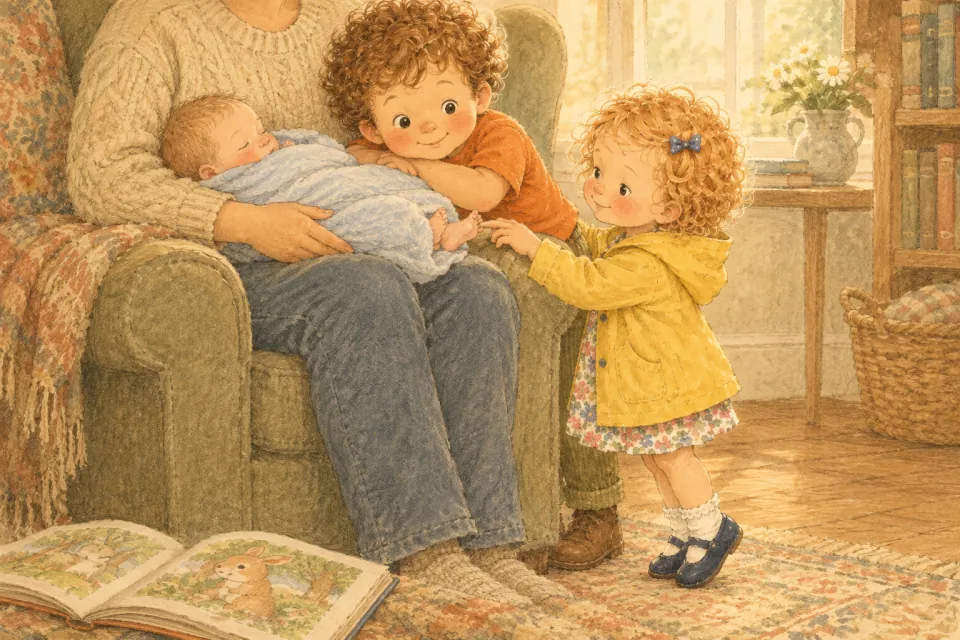
Dad shifted a cushion. “There’s room beside me. The baby is in my arms, and I can listen to you.”
Pip climbed up with the truck.
“My mountain fell.”
“Tell me about it.”
Pip told the whole mountain story. The baby made a squeaky sound.
“Was that a question?” asked Pip.
“I don’t know,” said Dad. “Babies have lots of sounds.”
Pip tried a squeak. Then a rumble. Dad smiled.
Later, another grown-up held the baby. Dad came to the rug.
“Truck or book?” Dad asked.
“Book. And truck.”
They opened the book on the yellow cushion. Pip parked the truck beside the pictures.
There were new sounds in the house. There were new things to learn.
And there was still a place beside Dad for Pip.
Keep the conversation as small as the story
You can stop after any sentence. “Which cushion would you choose?” is enough. A child may want to talk about the truck instead of the baby. That is still sharing a story together.
If your child asks a real question, step outside the fiction and answer about your own home. Perhaps a grandparent will be there, perhaps another parent, or perhaps you don’t know yet. The story’s arrangement is an example, not a plan your family has to follow.
The American Academy of Pediatrics recommends being honest that a new baby needs attention and may not be an immediate playmate. It also suggests looking at the older child’s baby pictures together (preparing your family for a new baby). Those are useful details to borrow for a family story: what babies actually do, and a reminder that this older child was once the tiny person in the photograph.
For published books to borrow or buy, our big sister and big brother book guide groups choices by before the arrival, after the baby comes home, and the feelings in between.
A little world that still belongs to them
This studio film imagines a blanket fort opening into a storybook forest. It is a campaign film about imagination, not footage of the app creating a book. It suggests a useful creative choice: give the older child a favorite place and an adventure of their own.
A blanket fort opens into a lantern-lit forest.
An imaginative campaign film. Once Upon Us makes illustrated, narrated picture books.
Film description & transcript
A blanket fort opens into a lantern-lit forest. Instrumental music; no spoken narration.
A sibling book can include a new baby without making every page about the baby. A red truck, a fort, a stuffed animal, or the walk to the park can carry the story. “Tell me about your mountain” gives Pip something to say beyond whether being a big sibling is fun.
Make your own eight-page sibling book
Use this as a writing outline, whether you draw it on folded paper, arrange pictures in a private document, or describe it to a story-making tool. Eight pages is a convenient creative constraint, not a required length for a particular age.
- Here is my world. Show your child doing something they enjoy. Write one concrete sentence: “I build tall towers with the blue blocks.”
- Someone new is coming, or has arrived. Use the timing that is true today. Avoid an exact arrival promise if you don’t have one.
- Here is one thing babies do. Choose one ordinary detail, such as crying or sleeping. Keep it simple and factual.
- Here is something I wonder. Use your child’s actual question if they have one. A question about toys or seats belongs here as much as a question about love.
- Here is something I can choose. The child might pick a book, show a toy, or keep playing. Leave room for declining an invitation.
- Here is how a grown-up responds. Write a response your family can actually offer, without promising that waiting will never happen.
- Here is a familiar moment. Use an ordinary activity your child knows: a story on the couch, a walk, or building a small tower together.
- Here I am, still me. Return to the first-page interest. The last picture might be another blue tower, with a grown-up sitting nearby.
Read your draft aloud once without pictures. If a line sounds like a grown-up speech, shorten it. “You remain a valued member of our expanding family” might become “I love sitting here with you.” If it sounds like an instruction manual, give the child something to notice or do.
Five details that make it your child’s book
Start with a nickname, a favorite object, a familiar room, a phrase your child uses, and one small thing that happened. You do not need a full biography. In the example, the red truck does more work than a list of personality traits would.
Let a child choose between two possible covers, or decide where the toy goes in a picture. If you use photographs, choose ones you already have permission to use and keep the first version within your family. Our family-photo storybook guide walks through selecting and sequencing pictures.
A photo of the older child as a baby can become a separate “when you were tiny” page. Keep the wording warm and descriptive: “Here you are in my arms.” You don’t need to compare who cried more, slept better, or needed more help.
The AAP’s guide to sharing books at ages two and three encourages conversation about pictures and welcomes children’s questions. Leave an opening for those interruptions instead of making finishing the book the goal.
Read and listen to a different sibling adventure
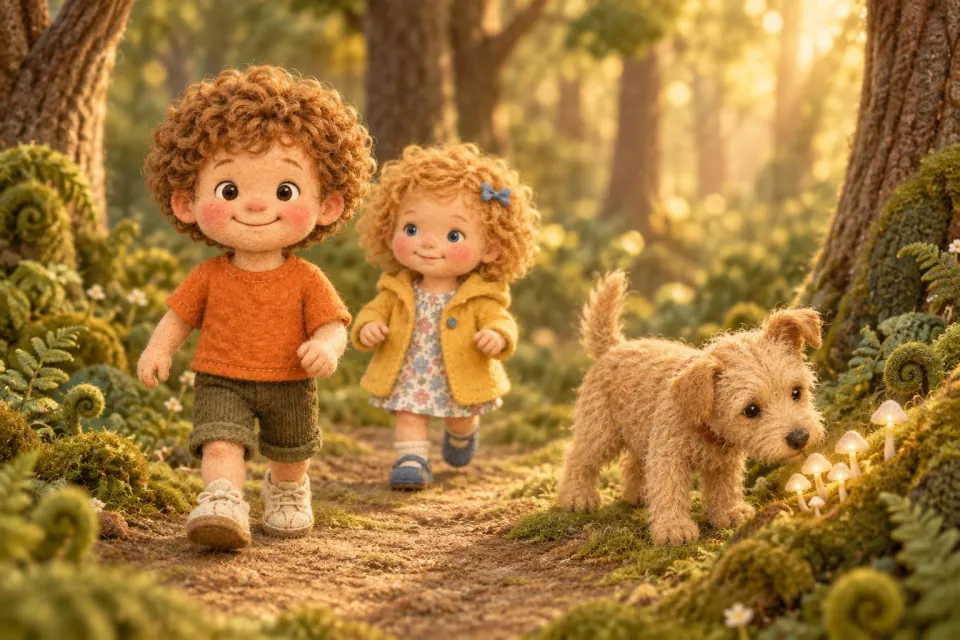
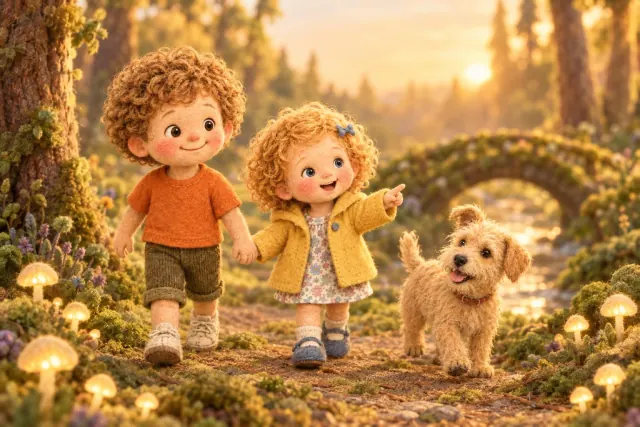
The complete book below follows Pip and Wren along a glowing path. It is a separate story about two siblings exploring together, rather than the new-baby story above. Turn the pages or choose “Read it to me” to try the illustrated, narrated format.
The whole story · Read & listen
Pip and Wren and the Glowing Path
Two siblings, a mossy bridge, and a forest adventure that needs both of them.
The end. Their next adventure could star your family. Join free early access →
Free to explore. No sign-in. Fictional children; AI-made words, pictures and narration. Read together at your own pace.
Read the complete story as text
Into the woods went Pip and Wren. Crunch, crunch, crunch went four small boots. Biscuit trotted behind. Sniff, sniff!
A big mossy log lay across the path. Wren's legs were too little. "You help me, I help you," said Pip.
Up, up went Wren. Over the log! "Again!" she laughed. Moss the snail waved his wobbly eyes. Hello!
Can you wave like Moss?
The woods grew dim. Which way home? Wren pointed. "Glow!" Little lights lit the mossy bridge. "You help me, I help you," whispered Pip.
Goodnight log. Goodnight snail. Goodnight little glowing lights. Pip and Wren curled up, proud of each other. Shhh.
You can enjoy a sibling adventure without making it a lesson about the next day’s behavior. Ask about a color, a creature, or a place they would like to explore. Reach Out and Read’s family resources offer more ways to make shared reading playful, including voices, sounds, and conversation.
Turn a familiar moment into your next story
For a written starting point, try: “A child with a red truck wants a place beside their parent while a new baby is being held. Let the child ask questions and keep playing. End with a small shared reading moment. Use our family’s words for the grown-ups.” Review the result and change anything that doesn’t sound like home.
Once Upon Us currently creates illustrated, narrated books from a written description for invited families. Invited families can also add face photos and photos of a day. You can see how personalized stories work or join free early access when you’d like to try making your own. The complete public samples remain free to read without signing in.
Questions parents ask
Can I read this new baby story before the baby arrives?
Yes. Introduce it as a made-up story about what a day with a baby might be like. Change details to match your family, and leave out plans you cannot promise.
Can I make it a big sister story or a big brother story?
Yes. Replace Pip with your child’s name or nickname and use the sibling words your family uses. Keep the older child’s interests and wishes in the story, too.
Do I need photos to make a personalized sibling story?
No. A name, favorite toy, familiar reading spot, and ordinary moment can make a story personal. Once Upon Us accepts a written description and optional photos from invited families.
Does the illustrated book on this page tell the same story?
No. The short new-baby story is written below. The illustrated and narrated sample is a separate sibling adventure about Pip and Wren exploring together.