
Big sister and big brother books for toddlers expecting a new baby
Eleven big sister and big brother books for 2- to 4-year-olds, sorted by when to read them, plus how to prepare a toddler for the baby and what to expect after.
In this post
A new baby is about the biggest change a 2- or 3-year-old can go through, and books are one of the easiest ways to get them ready. Zero to Three, the early childhood nonprofit, recommends sharing stories about new babies because they help a first child understand what’s happening and what’s coming (Zero to Three).
The best big sister and big brother books are honest. They show that babies cry, sleep a lot and need feeding, that the big kid still gets loved, and that mixed feelings are allowed. Below are eleven we’d reach for, sorted by when to read them. After the list: how to prepare a toddler for the baby, what usually happens once the baby is home, and some words that help.
Big sister and big brother books, by when to read them
Ages are a rough guide. A book that’s a little old for your child can still work if you shorten it as you read.
Before the baby comes
- Waiting for Baby by Rachel Fuller. A short, simple book with matter-of-fact explanations of what getting ready for a sibling looks like. Good for the youngest listeners.
- There’s Going to Be a Baby by John Burningham, illustrated by Helen Oxenbury. A young boy imagines what life will be like once his sibling arrives, and the book makes room for his questions and doubts as well as his excitement. Best for 3 and up.
Once the baby is home
- My New Baby by Rachel Fuller. The companion to Waiting for Baby, showing everyday life with a newborn from a toddler’s point of view in very simple language.
- I’m a Big Sister and I’m a Big Brother by Joanna Cole, illustrated by Rosalinda Kightley. Two versions of the same book: the big kid lists what’s fun about the new baby and what’s good about already being big. A steady favorite for 2- to 4-year-olds.
- Big Brother Daniel by Angela C. Santomero. Daniel Tiger helps out with the new baby, in simple words. If your child already knows the show, this one tends to get asked for.
- Lola Reads to Leo by Anna McQuinn. Lola reads stories to her new baby brother, and even though her parents are busy, they still read to her at bedtime. It quietly makes the point that the big kid’s time hasn’t disappeared.
- The New Baby by Mercer Mayer. Little Critter finds that a new baby takes some getting used to. Best for 3 to 5.
For the harder feelings
- Peter’s Chair by Ezra Jack Keats. Peter’s old blue furniture is being painted pink for his new sister, so he rescues his chair and runs away with it. A gentle classic for 3 and up about feeling replaced.
- A Baby Sister for Frances by Russell Hoban. Things change at home after the baby arrives, so Frances decides to run away, but not very far. Good for 3 to 6.
- Julius, the Baby of the World by Kevin Henkes. Lilly is sure her baby brother is the worst thing that ever happened, until a cousin is rude about him. Funny and honest about jealousy, and best from about 4.
For reassurance
- You Were the First by Patricia MacLachlan. A reminder to firstborns that they did everything first, including teaching their parents how to be parents. A nice one to read just to the older child.
Zero to Three keeps a longer list, sorted the same way, if you want more (Becoming a Big Sister/Brother: Stories to Share).
How to prepare a toddler for a new baby
Books help, but what does the most is the daily stuff: a predictable routine, honest answers, and time alone with you.
When to tell them
Toddlers live in the present. KidsHealth points out that preschoolers may not grasp concepts of time, so “in a few months” doesn’t mean much. It suggests linking the arrival to a season instead, like winter or “when it’s cold outside” (KidsHealth). The American Academy of Pediatrics suggests bringing the baby up in natural moments, such as shopping for baby clothes or setting up the nursery, and even for 1- and 2-year-olds, mentioning it early so they get used to the idea (HealthyChildren.org).
For most families that means talking about it casually once the pregnancy is visible or the nursery starts to take shape, then returning to it often in small doses.
Tell the truth about babies
The AAP’s advice is to be honest: the baby will be cute, but will also cry and take a lot of your time (HealthyChildren.org). Toddlers often picture a playmate. A newborn who mostly sleeps and cries can be a letdown if nobody warned them.
Two things that help:
- Look at your child’s own baby photos together. “This was you. You were this small. You cried too, and we fed you and held you.”
- Visit a friend with a newborn if you can, so the real thing isn’t a surprise.
Move big changes out of the way
Both the AAP and KidsHealth suggest timing major transitions, like potty training or moving from a crib to a bed, well before the due date or a while after the baby has settled in (HealthyChildren.org, KidsHealth). A toddler who loses their crib and gains a sibling in the same week can easily connect the two.
Give them a real job
Let them pick a baby outfit, choose a toy for the baby, or help put the crib sheet on. After the birth, simple jobs like fetching a diaper or picking which song to sing keep them in the middle of things. Zero to Three adds one important detail: helping should be an invitation, not a requirement. “It’s okay if you don’t want to help right now” keeps the job feeling good (Zero to Three).
What to expect after the baby arrives
Some backsliding
Accidents after potty training, baby talk, asking for a bottle or wanting to be carried again are all common. The AAP says this is normal and is “your older child’s way of making sure they still have your love” (HealthyChildren.org). Zero to Three’s advice is to stay matter-of-fact rather than shaming them, because meeting the need underneath usually helps them move on faster (Zero to Three). If potty learning was recent, expect a few wobbles (our potty training books guide has ideas for getting back on track).
Mixed feelings
Excitement about a baby “someday” often turns into something more complicated once the baby is real and needs you all the time. Name the feeling without trying to fix it. Zero to Three offers a line like “It is so hard to wait while I feed your sister,” followed by a small plan for what you’ll do together after (Zero to Three). If the feelings come out as tears or tantrums, our guide to toddler big feelings has more on helping them put words to it.
Rough hands
Squeezing too hard, poking, or a swat at the baby is common and doesn’t mean your child is unkind. Zero to Three suggests calmly taking hold of their hands and showing the gentle way, and framing the limit around the rule rather than the baby, since “you have to protect the baby” can feed rivalry (Zero to Three). For scripts and what to do when hitting keeps happening, see gentle hands: how to stop a toddler from hitting.
Time that belongs to them
Both the AAP and Zero to Three recommend daily one-on-one time with the older child, even a short stretch, with the baby somewhere else (HealthyChildren.org, Zero to Three). Name it so they can count on it: “This is our time. The baby is with Dad.”
Words that help
Avoid anything that makes the baby the reason for a no, like “Be quiet, you’ll wake the baby” said every hour. Where you can, say what’s happening instead: “The baby is sleeping. Let’s use whisper voices, then we’ll be loud outside.”
A story to rehearse being a big sibling
Books about other families are a good start. A story where your own child is the big sibling is even more direct, because they get to see themselves doing the helping. Here’s a short example starring two made-up kids, Pip (3) and Wren (2), and their new baby brother.
An example story
Pip, Wren and Baby Otto
Cozy Pencil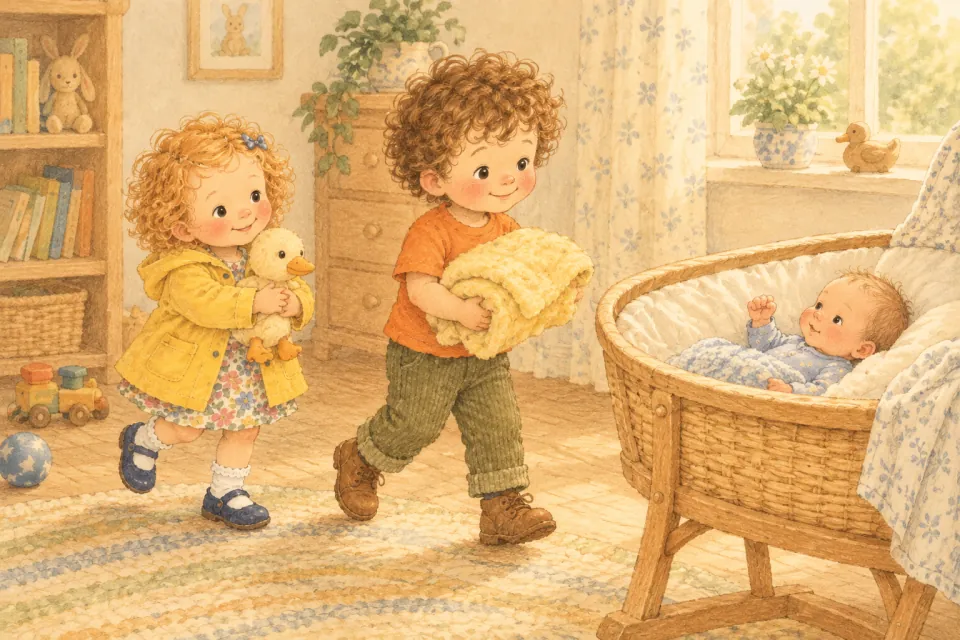
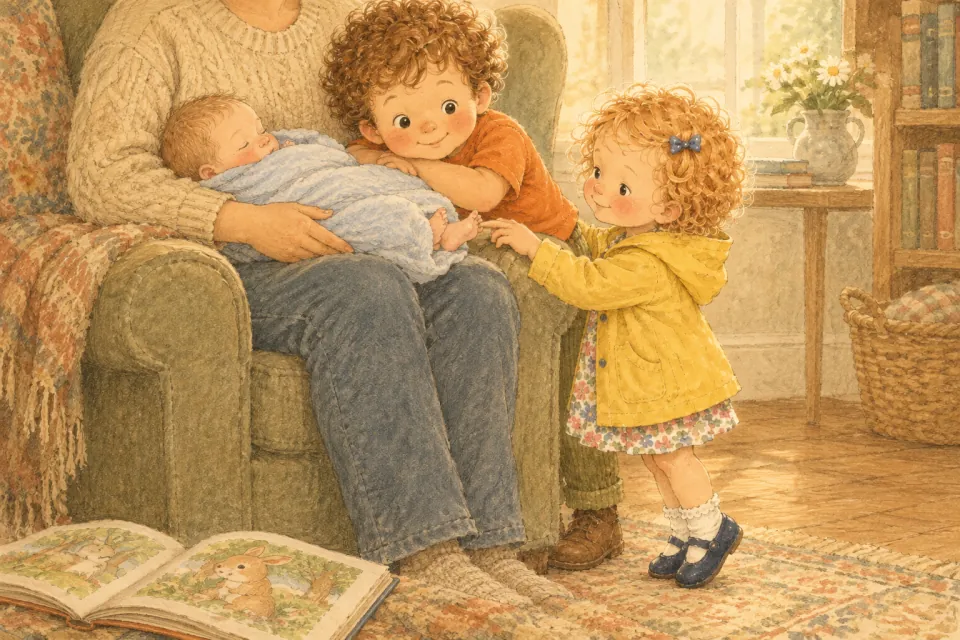
Baby Otto came home in a blue blanket. He was very small. “Waa! Waa!” said Otto. “He’s cold,” said Papa. Zoom! Pip ran for the yellow blanket. Wren brought the soft duck. Helper hands!
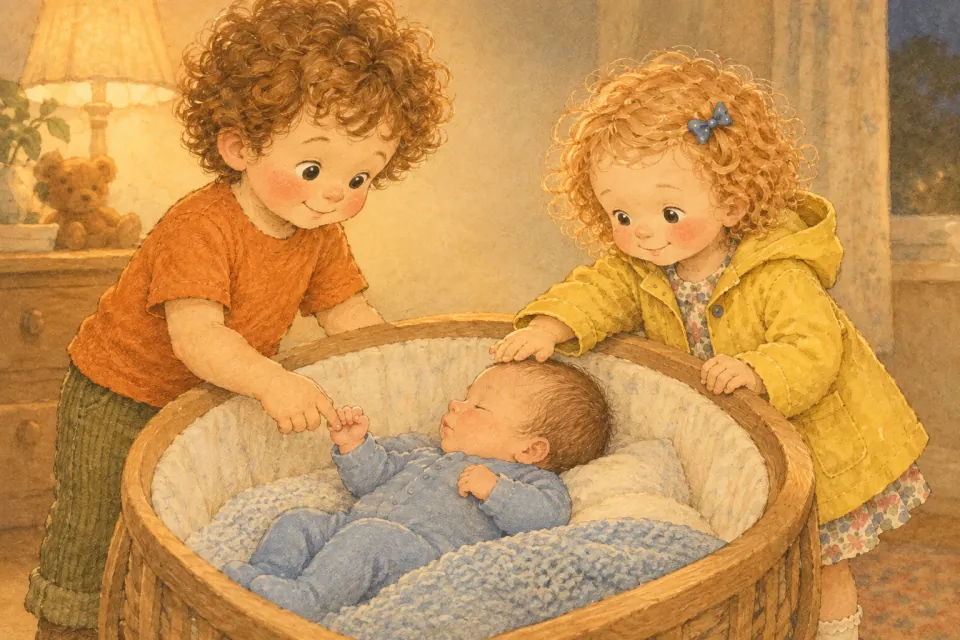
Otto grabbed Pip’s finger. Squeeze! “He likes me,” Pip whispered. Wren patted Otto’s head, soft as a feather. Pat, pat. Helper hands, gentle hands. That night Otto slept, and Mama read one more story, just for Pip and Wren.
The story shows the helping instead of explaining it, and there’s a repeatable phrase (“helper hands”) a toddler can say out loud the next day. It also ends with the big kids getting a story of their own, a small reminder that their time with you hasn’t gone away. Once Upon Us can weave this kind of lesson into a picture book made from your family’s own photos (see how lessons work), but a homemade version works too: a few phone photos of your child with the baby, a sentence under each, stapled together. Our guide to writing a social story walks through how.
Questions parents ask
When should I tell my toddler about the new baby?
There’s no perfect week. Toddlers don’t track months, so it helps to tie the arrival to something they can picture, like “when it’s cold outside”, and to bring it up in ordinary moments, like when the crib goes up. Short and often beats one big talk.
Is it normal for a toddler to regress after a new baby arrives?
Yes. Potty accidents, baby talk, asking for a bottle or to be carried are all common. The American Academy of Pediatrics calls this normal and describes it as a child’s way of making sure they still have your love. A calm, matter-of-fact response usually helps it pass.
What should I do if my toddler hits or pushes the new baby?
Calmly take their hands, move the baby out of reach, and show what gentle touch looks like. Keep the rule about hands (“I won’t let you hit”) rather than about the baby. Our gentle hands guide has more scripts.
What’s a good big sister or big brother book for a 2-year-old?
Pick a short book about everyday baby life, like Rachel Fuller’s My New Baby or Joanna Cole’s I’m a Big Sister or I’m a Big Brother. Story-driven books like Julius, the Baby of the World land better from about age 4.
Sources
- Becoming a Big Sister/Brother: Stories to Share, Zero to Three
- “When Is He Going Back in Your Belly?” How to Help Older Siblings Adjust to the New Baby, Zero to Three
- Preparing Your Older Child for a New Baby: How to Help Siblings Adjust, HealthyChildren.org (American Academy of Pediatrics)
- Preparing Your Child for a New Sibling, KidsHealth from Nemours
- Book details checked against Open Library catalog records