
How to write a social story for your toddler (with an example)
What a social story is, how to write one for a 2- to 4-year-old in six steps, the sentence types that matter, and a full example about the dentist.
In this post
A social story is a short, simple story that tells your child what is going to happen, how people might feel, and what they can do. You write it about one real situation, like a dentist visit, a new baby or the first day at daycare, in words your child understands, ideally with photos of the real places and people. Then you read it together a few times before the day comes.
For a toddler, a good social story is a handful of pages, mostly describing, with only one or two “I can” sentences. Below is how to write one step by step, why the sentence mix matters, a complete example about going to the dentist, and an honest look at what the research says.
What a social story is
Carol Gray developed Social Stories in 1990 while working as a teacher in Jenison, Michigan (Carol Gray). Social Stories is her trademarked name for the format, and her own definition is careful: each story “accurately describes a personally relevant topic (often a context, skill, achievement, or concept)” according to ten defining criteria (Carol Gray). She designed them for autistic children, and they’re still widely used in autism support and in schools (Hanrahan et al.).
The same idea works for many young children. A parent guide from the National Center for Pyramid Model Innovations, funded by the U.S. Department of Education, describes social stories as brief, simple stories that show a child “what to expect, and what is expected of him,” and suggests them to (NCPMI):
- teach social skills, like taking turns
- set clear expectations for a time of day or an event, like quiet time or a road trip
- reinforce routines, like getting ready for bed
- prepare for new experiences, like the first day of school
- address a challenging behavior, like hitting
What makes a social story different from a regular picture book is that it’s about your child’s actual situation. The dentist in the story is the dentist they’ll see. The chair tips back because the real chair tips back. Nothing in it should turn out to be untrue.
The sentence types that make it work
Gray’s approach mixes a few kinds of sentences. The names vary a little between guides; these four are the core:
- Descriptive sentences state facts, free of opinion. “The dentist’s office has a big chair.”
- Perspective sentences describe feelings and thoughts, the child’s or someone else’s. “Sometimes the light feels bright.” “Mama feels proud.”
- Coaching sentences (often called directive sentences) say, in positive terms, what the child can do. They often start with “I can” or “I can try.” “I can hold Bun-bun.”
- Affirmative sentences add reassurance or a shared value. “The dentist helps keep teeth strong.”
The most important rule is balance: a social story describes much more than it directs. Gray’s criteria set a minimum of two describing sentences for every coaching sentence (Hanrahan et al.), and a UK National Health Service guide suggests aiming closer to five (NHS). A story that’s all “I will sit still, I will not cry” is a list of rules, and toddlers tune those out.
A few more guidelines from the same sources:
- Keep the tone positive and patient. Say what to do, not what not to do (Hanrahan et al., NHS).
- Use first or third person. Gray’s criteria allow either (Hanrahan et al.). For a toddler, first person (“I go to the dentist”) is usually easiest to follow.
- Leave room for things to vary. Words like “sometimes” and “usually” keep the story true even if the day goes differently (NHS).
- Tense can match the situation. Present or future tense suits an event that hasn’t happened yet (Hanrahan et al.).
How to write a social story in six steps
- Pick one situation. One visit, one routine, one behavior. “Going to the dentist,” not “being good.”
- Gather the details. Where it happens, who will be there, how long it takes, what happens first and last, and any words that tend to worry your child (NHS). If you can, call ahead or look at the place’s photos online.
- Write short pages in your child’s voice. One idea per page, one or two sentences each. Use the words your child uses: “Bun-bun,” not “your stuffed animal.”
- Add real pictures. The parent guide above notes that social stories can include pictures of your child (NCPMI). Photos of the real building, the real room and your child are the most concrete. Simple drawings work if you don’t have photos.
- Read it before the day, more than once. Read it at a calm time, like after lunch or at bedtime, a few days in a row. The point is to make the new situation familiar before your child is expected to handle it (NCPMI).
- Watch and adjust. If a page makes your child anxious, change it. If they ask the same question every time, add a page that answers it. After the event, you can add a last page about how it went.
Example social story: Going to the dentist
Here’s a complete example starring a made-up 3-year-old named Pip. In a real one, you’d swap in photos of your own child and the actual office.
An example story
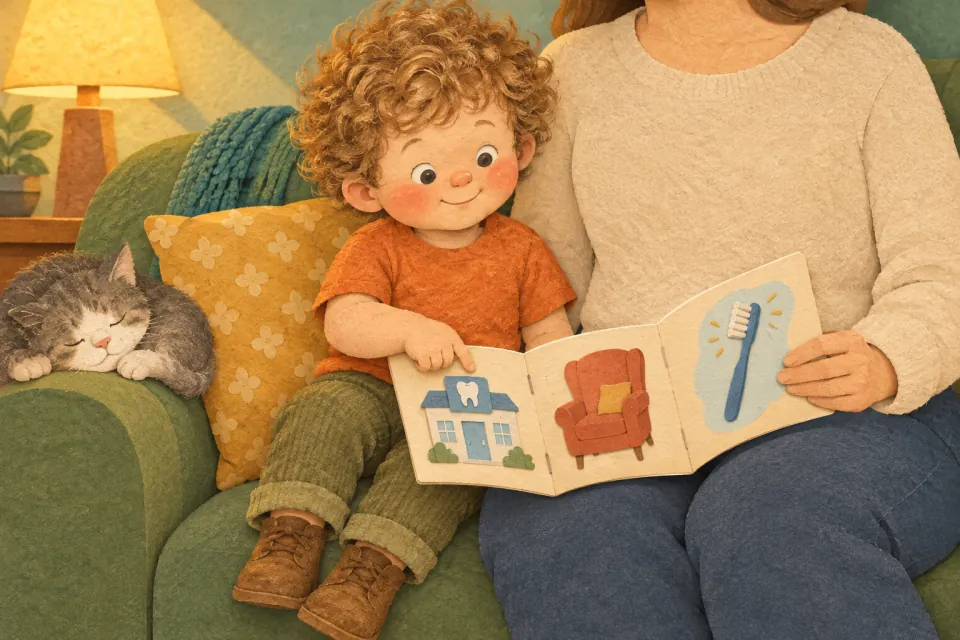
Pip Goes to the Dentist
Paper Diorama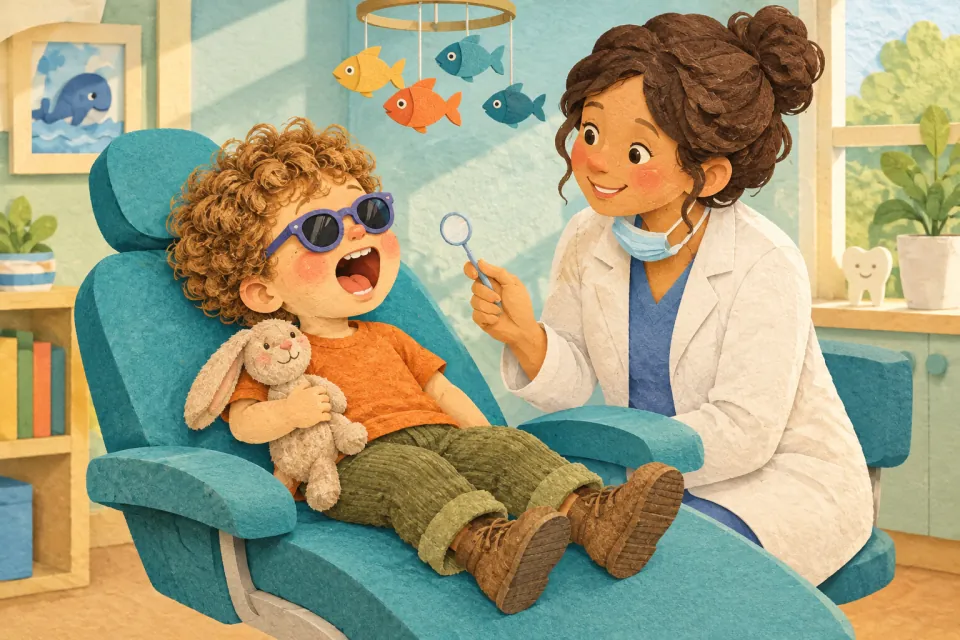
Today I am going to the dentist. The dentist helps keep my teeth strong. At the dentist, there is a big chair. Sometimes the chair tips back, slow and gentle, like a sleepy slide. The light is bright. I can wear the funny sunglasses. The dentist counts my teeth with a tiny round mirror. Sometimes it tickles. I can open wide like a lion. Roar! I can hold Bun-bun the whole time.
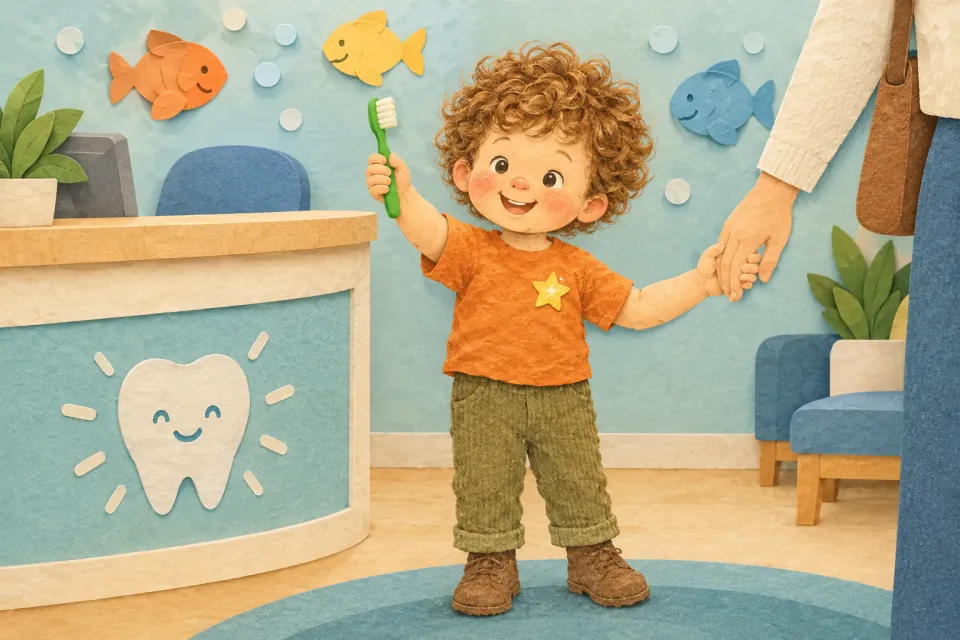
When the dentist is all done, I usually get a new toothbrush. Mama feels proud of me. I feel proud too. Then we go home.
Count the sentences and you’ll find three coaching sentences (“I can wear the funny sunglasses,” “I can open wide like a lion,” “I can hold Bun-bun the whole time”) against a dozen describing and perspective sentences. “Sometimes it tickles” prepares Pip for a feeling without promising it, and “usually get a new toothbrush” keeps the story true if this office hands out stickers instead. The lion roar gives a nervous toddler something fun to do with their open mouth.
More social stories to write for toddlers
Once you’ve written one, the format works for almost any new or hard moment:
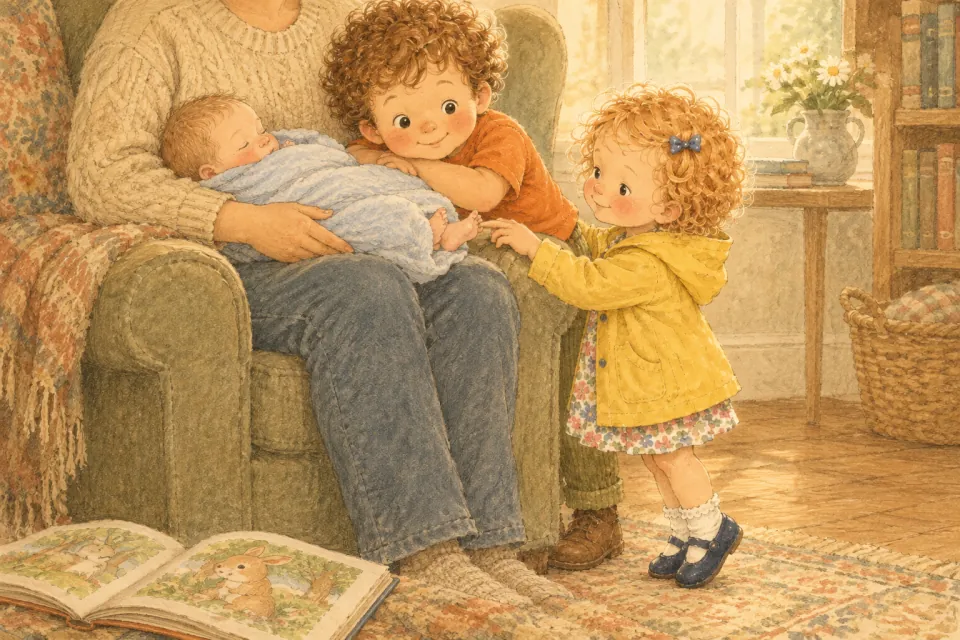
- A new baby coming home. What newborns do, where the baby sleeps, what the big kid can help with. Our big sister and big brother books guide covers what to expect.
- Gentle hands with a friend. What happens when two kids want the same toy, what your child can say instead of hitting. See gentle hands: how to stop a toddler from hitting for the words to use.
- Starting daycare or preschool. Drop-off, the goodbye routine, who picks up.
- A haircut, a doctor’s visit, or a first plane ride.
- Big feelings. What your child can do when they feel mad or sad. Our toddler big feelings guide has phrases that fit well on a page.
- Bedtime. The steps of your routine, in order, ending with lights out.
Paper, phone photos, or a picture book
A homemade social story doesn’t need to be pretty. A few phone photos printed at the drugstore, one sentence under each, stapled or slipped into a small photo album, is a real social story. Some families keep them on a phone, which is handy in a waiting room.
We build Once Upon Us, which turns photos from your family’s real day into an illustrated picture book with a gentle lesson woven in, like being brave (see how lessons work). That’s a close cousin of a social story, with your own child as the hero. It’s still a storybook, though. If your child works with a therapist or a school team, follow their guidance on how social stories are written and used for your child.
What the research says
Social stories are widely used with autistic children, particularly in schools, and the research behind them is mixed. A large number of case studies report improvements in the specific behavior a story targets, and a 2020 pilot randomized trial found that children whose stories were delivered on a tablet improved on their target behaviors compared with a control group, with gains holding six weeks later (Hanrahan et al.). At the same time, systematic reviews and meta-analyses find major inconsistencies across studies, which the trial’s authors link partly to stories not being written and used the way Gray describes, and they keep calling for better-controlled research (Hanrahan et al.).
For a parent, the practical takeaway is modest: a well-written social story is cheap, gentle and easy to try. Watch how your child responds. If it calms them, keep it. If it doesn’t, you’ve lost an evening of stapling.
Questions parents ask
What is a social story?
A short, personalized story that tells a child what will happen in a specific situation, how people might feel, and what the child can do. Carol Gray developed the format in 1990, and Social Stories is her trademarked name for it.
Are social stories only for autistic children?
They were created for autistic children and are widely used with them, but the same format helps many young children. A U.S. Department of Education-funded guide for parents suggests them for new experiences, routines like bedtime, taking turns and behaviors like hitting.
How long should a social story be for a toddler?
Short. A few pages with one or two simple sentences each is plenty for a 2- or 3-year-old. If your child loses interest halfway, cut it down.
Do social stories actually work?
The evidence is mixed. Some studies show improvements in the behavior a story targets, while reviews point to inconsistent results and call for better-designed studies. They’re cheap and low-risk, so watch how your child responds and adjust.
Sources
- Social Stories and What is a Social Story?, Carol Gray
- How to Use Social Stories to Teach Your Child New Skills and Expectations, National Center for Pyramid Model Innovations (Backpack Connection Series)
- How to write a social story, Nottinghamshire Healthcare NHS Foundation Trust
- A Pilot Randomised Control Trial of Digitally-Mediated Social Stories for Children on the Autism Spectrum, Hanrahan et al., Journal of Autism and Developmental Disorders (2020)