
Gentle hands: how to stop a toddler from hitting
Why toddlers hit, what to say in the moment, and how to practice gentle hands when everyone is calm and at bedtime. Scripts for ages 2 to 4, with sources.
In this post
Most toddlers hit at some point. Usually a big feeling has shown up before the words and the self-control to handle it. What helps is the same small routine, repeated many times: stop the hand calmly, say one short line, give those hands something else to do, and practice gentle hands later, when nobody is upset.
It’s slow. It also teaches your child what to do instead of only what to stop, which is the part that sticks.
Why toddlers hit
A toddler’s feelings run ahead of their language. ZERO TO THREE, the early-childhood nonprofit, describes toddlers as relying on their actions to “tell” us what they’re thinking and feeling, and notes that aggressive behavior like hitting, biting and pushing tends to peak between 12 and 24 months, when feelings are strong and words are few (ZERO TO THREE).
Knowing the rule isn’t the same as being able to follow it. Between 2 and 3, children start to understand what’s acceptable, but they “still do not have the full ability to stop themselves from doing something, even though they have been told it is unacceptable” (ZERO TO THREE). So when your 2-year-old swats a sibling and then looks right at you, it isn’t always defiance. The impulse simply won that round.
Some things make hitting more likely. Hunger and tiredness are the big two (the AAP suggests carrying a snack and protecting naps when tantrums cluster around them, HealthyChildren.org). Transitions, crowded play and a sibling grabbing a toy are the other usual suspects. It helps to notice when your child hits. Often there’s a pattern: right before dinner, at pickup, when the baby cries.
What to expect at 2, 3 and 4
Knowing what’s typical makes it easier to stay calm.
- Around 2, many children notice when someone else is hurt or upset and look at your face to see how to react (CDC). Empathy is starting, but control isn’t there yet. They are watching how you respond.
- Around 2½, children play next to other kids and only sometimes with them (CDC). Shared space and shared toys are new, and that’s where many hits happen.
- By 4, many children comfort someone who is hurt or sad, like hugging a crying friend (CDC).
In between is a lot of practice. ZERO TO THREE puts it plainly: it takes thousands of repetitions, hearing the words together with the actions, before the words alone will work (ZERO TO THREE). If you’ve said “gentle hands” two hundred times this month, you are on schedule.
What to do in the moment
1. Stop the hand, calmly
Block the hit, hold your child’s hands, or move one child away. When one child is hitting another, the AAP’s advice is to pull the children apart and keep them separate until they’ve calmed down (HealthyChildren.org). ZERO TO THREE suggests pairing a firm, matter-of-fact “No hitting, hitting hurts” with gently holding the hand, and staying calm yourself, because a calm adult helps a child settle faster (ZERO TO THREE).
Say it once, quietly. A long explanation mid-meltdown doesn’t land, and a big reaction can make hitting more interesting.
2. Name the feeling in a few words
Your child needs to hear that the feeling is allowed even though the hit isn’t. Keep it short.
3. Give the hands a job
“Stop hitting” leaves a toddler with a body full of mad and nowhere to put it. Offer something physical instead. ZERO TO THREE’s suggestions include jumping up and down, hitting the sofa cushions and throwing soft balls (ZERO TO THREE).
4. Turn to the child who got hit
If a sibling or friend was hit, comfort them out loud: “Ouch, that hurt. Are you okay?” Your toddler sees what care looks like, and the one who was hit gets your attention first.
What to skip
- Don’t hit back or spank. The AAP advises that parents should not spank or hit children, and notes that spanking tends to increase aggression and anger rather than teach self-control (HealthyChildren.org). Tapping a hand “so they know how it feels” teaches that bigger people hit.
- Skip threats. “Stop it or else” works less well than showing what to do instead (HealthyChildren.org).
- Keep time-outs rare. The AAP’s tips for preventing aggression say to use them sparingly, as a last resort (HealthyChildren.org). ZERO TO THREE suggests a “cozy corner” instead, a soft spot with pillows and books where a child can settle (ZERO TO THREE). For a 2-year-old, that usually works best with you sitting nearby.
Teach gentle hands when everyone is calm
Most of the teaching happens outside the hard moment, when your child can take it in.
Show what gentle hands look like. Pat a stuffed animal together, softly. Stroke the dog’s back, slowly. Trade high fives, then “gentle fives.” Give it a phrase you’ll use every time. We like “gentle hands, soft as a bunny,” but any short, singsong line works if you stick with it.
Catch them being gentle. The AAP recommends noticing good behavior and praising it specifically (HealthyChildren.org). “You patted Wren so softly. Look how happy she is” teaches more than a general “good job.”
Say the family rule the same way every time. One of the AAP’s tips is a simple, consistent rule: “We don’t hurt each other” (HealthyChildren.org).
Plan around the triggers you’ve noticed. A snack before the playground. A heads-up before it’s time to leave, which ZERO TO THREE recommends for transitions (ZERO TO THREE). Closer supervision when siblings share one toy. If toy fights are behind most of the hitting, our guide to teaching a toddler to share has scripts for those.
Read about it. Hands Are Not for Hitting by Martine Agassi, illustrated by Marieka Heinlen, is the book many families reach for. It’s part of Free Spirit Publishing’s Best Behavior series, comes as a board book for the youngest readers, and focuses on all the good things hands can do (Free Spirit). Karen Katz’s lift-the-flap No Hitting! and Cheryl Willis Hudson’s Hands Can are two more short reads for toddlers.
Rehearse it at bedtime, in a story
Bedtime is a good time for practice. Everyone is calm, your child is curled up next to you, and a story lets them watch someone their size get it right.
There’s some early evidence that this helps. In a 2023 study in PLOS One, three-year-olds read a picture book in which a child distracted herself with toys while waiting for something she wanted. When the book was read interactively, and after the researchers accounted for how much picture-book experience each child had, the children used distraction more in a later waiting task than children who read an unrelated book (Schoppmann et al., PLOS One). It’s one small study about waiting, not hitting, so hold it loosely. The idea behind it is simple, though: a phrase your child has heard in a calm story is one they can reach for in a hard moment.
A story that helps with hitting has a few parts: the mad feeling shows up, the character pauses and does something physical instead, the same short phrase comes back each time, and the gentle choice pays off in a way a toddler cares about. Here’s a short one starring two made-up kids, Pip (3) and his sister Wren (2):
An example story
Pip and the Wobbly Tower
Cozy Pencil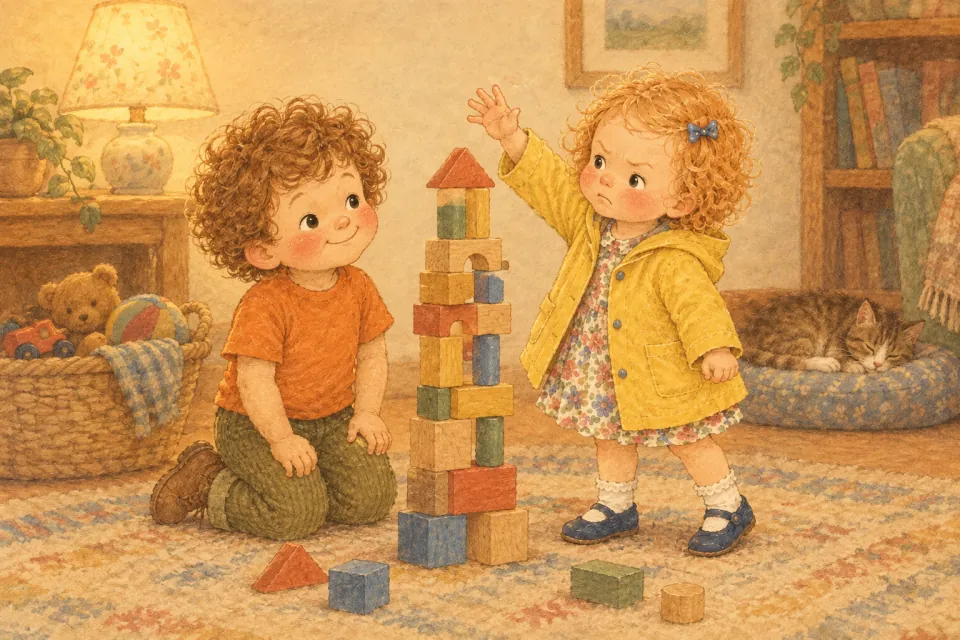
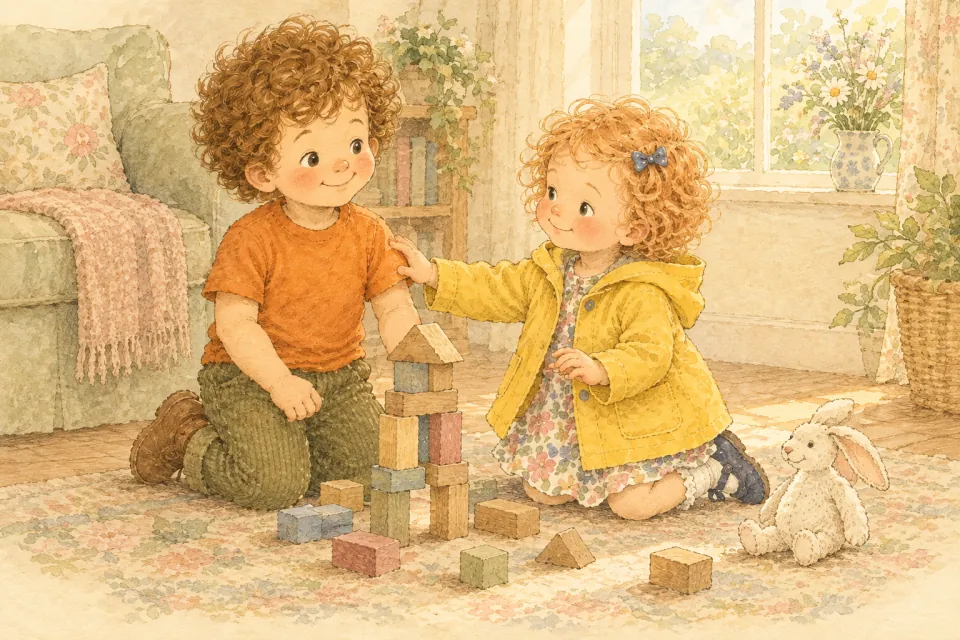
Pip built a tower. Up, up, up it went! Wren wanted it. Her face got hot. Her hand went up, up, up, ready to swat. Whoosh!
But Wren stopped. She squeezed her hands tight. Squeeeeze. Then she opened them, soft and slow.
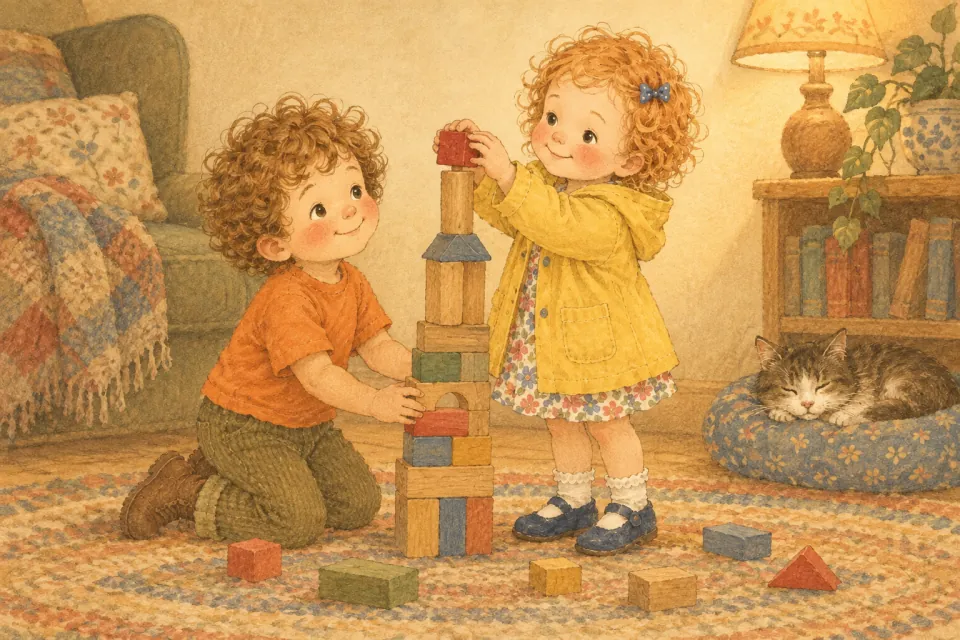
Pat, pat, pat, on Pip’s arm. “Gentle hands, soft as a bunny,” said Pip. “Want to put the top block on?”
Wren set the red block on top. Wobble, wobble... it stayed! Two builders, four gentle hands, and one very tall tower.
The hit almost happens, so your child recognizes the feeling. The pause is something a body can do (squeeze, then open). The phrase repeats, and the gentle choice gets a real reward: a turn, and a tower that stays up. Afterward, ask “What did Wren’s hands do?” and let your child show you. Once Upon Us can write this kind of story around your own kids and a real day from your photos, with gentle hands woven in as the lesson.
When to talk to your pediatrician
Hitting on its own, at 2 or 3, is common. The AAP suggests talking to your pediatrician if your child seems unusually aggressive for more than a few weeks and you can’t manage it on your own, or if there are warning signs like injuries (teeth marks, bruises), attacks on adults, being sent home or barred from play by neighbors or school, or your own fear for the safety of the people around your child (HealthyChildren.org). ZERO TO THREE adds hitting that seems to come out of nowhere, very reckless behavior, a preoccupation with aggressive play, or aggression that’s getting in the way of learning and relationships (ZERO TO THREE).
It’s also worth raising if you’re worried about how your child is talking or understanding. The CDC’s free milestone checklists are a good way to bring specifics to the appointment (CDC). A lot of hitting is frustration at not being understood, and it often eases as words come in. For more on that side, see our guide to toddler big feelings and tantrums.
Questions parents ask
Is it normal for a 2-year-old to hit?
Yes. Hitting is one of the most common ways toddlers show big feelings before they have the words for them. ZERO TO THREE notes that aggressive behavior tends to peak between 12 and 24 months, and it usually fades as language and self-control grow.
Should I tap my toddler’s hand so they learn how it feels?
No. The American Academy of Pediatrics advises parents not to spank or hit children, and says physical punishment tends to make children more aggressive, not less. Hold the hand, say the limit, and show what hands can do instead.
What should I do when my toddler hits me?
Block or hold the hand, step back if you need to, and say one calm line such as “I won’t let you hit.” Name the feeling, offer another way to let it out (stomping, squeezing a pillow), and reconnect once your child is calm.
My toddler keeps hitting the new baby. What can I do?
Keep the baby out of reach during hard moments, stay close when they’re together, and give your toddler gentle jobs like patting the baby’s feet or fetching a diaper. There’s more in our guide to preparing a toddler for a new baby.
When should I worry about my toddler hitting?
Talk to your pediatrician if hitting stays frequent for more than a few weeks despite a steady response, if someone is getting hurt, or if it comes out of the blue. Also mention it if you’re worried about your child’s talking, since frustration with words is often behind it.
Sources
- Aggressive Behavior in Toddlers, ZERO TO THREE
- Helping Toddlers Develop Self-Control From 24–36 Months, ZERO TO THREE
- 10 Tips to Prevent Aggressive Behavior in Young Children, HealthyChildren.org (American Academy of Pediatrics)
- What’s the Best Way to Discipline My Child?, HealthyChildren.org (American Academy of Pediatrics)
- Top Tips for Surviving Tantrums, HealthyChildren.org (American Academy of Pediatrics)
- Milestones by 2 years, 30 months and 4 years, CDC Learn the Signs. Act Early.
- The effect of picture book reading on young children’s use of an emotion regulation strategy, Schoppmann, Severin, Schneider and Seehagen, PLOS One (2023)
- Hands Are Not for Hitting, Martine Agassi and Marieka Heinlen, Free Spirit Publishing