
Toddler big feelings: tantrums, and teaching words for them
Tantrums are most common between 1 and 3. How to stay steady, name the feeling, hold the limit, and build your toddler's feelings words with books and stories.
In this post
Tantrums are a normal part of being a toddler. The American Academy of Pediatrics says they’re most common between ages 1 and 3 and tend to get better after 3 (HealthyChildren.org). In the moment, your job is to stay steady, give the feeling a name, and hold whatever limit started it. Later, you help your child find the words to use next time.
Big feelings don’t go away as children grow. What changes is that they learn to say “I’m mad!” instead of throwing the cup, and you can start teaching that now.
What’s happening in a toddler meltdown
ZERO TO THREE, the early-childhood nonprofit, lists a few reasons toddlers fall apart. They don’t always have the words to tell you how they feel. Their brains can’t yet “put on the brakes.” And they’re in a huge leap toward independence, which means wanting to do things they can’t do yet (ZERO TO THREE).
The usual triggers are easy to predict and hard to avoid: hunger, tiredness, a transition (“Time to leave the park”), a “no,” a sock that feels wrong. The AAP suggests carrying a snack if tantrums peak when your child is hungry and protecting sleep if they peak when your child is tired (HealthyChildren.org).
Temperament matters too. The AAP notes that personality shows up in tantrums, so some children have bigger, louder ones than their siblings did (HealthyChildren.org). An intense tantrum doesn’t mean you’re doing something wrong.
What to expect at 2, 3 and 4
- Around 2, children notice when others are upset and look at your face to see how to react (CDC). Your calm is information for them.
- Around 2½, a typical child says about 50 words (CDC). “Mad” may not be one of them yet, which is part of why the feeling comes out as a scream.
- Around 3, children can hold a short back-and-forth conversation (CDC), so you can start to talk about what happened once things are calm.
- Around 4, many children comfort others who are hurt or sad and can tell you about something from their day (CDC).
During the storm
Get calm yourself first
This one is hard, and it matters most. ZERO TO THREE’s advice is to keep yourself calm and present in the face of the tantrum (ZERO TO THREE). They call this co-regulation: young children don’t learn to regulate by being told to “calm down,” they learn by being calmed with (ZERO TO THREE). Lower your voice, slow your breathing, get down to their level.
Name the feeling in a few words
Give the feeling a name without arguing with it. ZERO TO THREE’s example: “You’re mad the block tower fell down. That makes sense” (ZERO TO THREE).
Short is better. A child in the middle of a meltdown can’t follow a paragraph.
Hold the limit, kindly
Naming the feeling doesn’t mean giving in. ZERO TO THREE describes it as honoring your child’s feelings while holding the limit (ZERO TO THREE).
Offer a small choice
The AAP suggests giving your child control over little things during a tantrum, with small choices rather than yes-or-no questions (HealthyChildren.org).
Don’t let hitting slide
You can wait out yelling and flopping. The AAP says not to ignore hitting, kicking, biting or throwing (HealthyChildren.org). Block the hand, keep everyone safe, and use one short line. Our guide to gentle hands and toddler hitting walks through it.
Let it pass, then reconnect
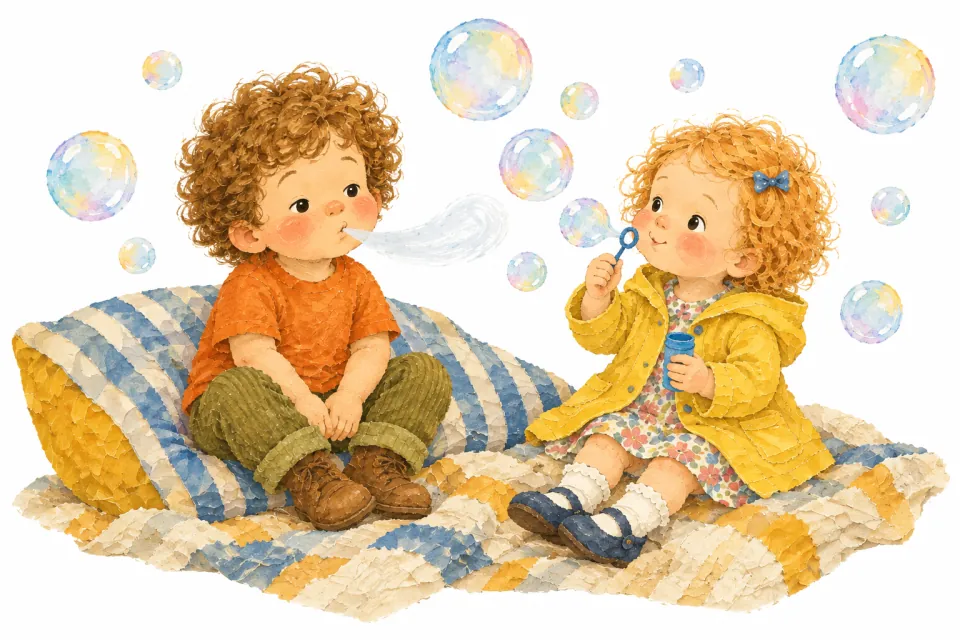
When nobody is in danger, the AAP’s advice is to stay calm and let the tantrum run its course, then comfort your child (HealthyChildren.org). ZERO TO THREE suggests a cozy corner with a pillow, a blanket and a stuffed animal where you sit together, and turning slow breathing into a game: “Let’s blow our big feelings out,” taking turns with bubbles (ZERO TO THREE).
After the storm: build the words for next time
ZERO TO THREE notes that toddlers don’t have all the words they need to share their thoughts and feelings (ZERO TO THREE). You can give them those words in calm moments, a few at a time.
Start small. Happy, sad, mad, scared, tired. Make the face, say the word, and let your child copy you in the mirror. Add frustrated, disappointed and excited later.
Name your own feelings out loud. “I feel frustrated. This lid is stuck. I’m going to take a big breath.” The AAP lists controlling your own temper, and showing your child how to handle anger calmly, as one of its tips (HealthyChildren.org).
Talk about it later, briefly. At bath time or bedtime: “You were so mad at the park. You yelled. Then we did bubble breaths. Next time you can say ‘I’m mad!’” You’re telling your child the story of their own feeling, with a better ending.
Head off the predictable ones. Give warnings before transitions, offer choices, and keep an eye on snacks and naps (ZERO TO THREE). A lot of tantrums start before anyone notices.
Books about feelings for toddlers
ZERO TO THREE suggests reading feelings books side by side, pointing to the characters’ faces and talking about what they feel (ZERO TO THREE). A few good ones:
- Big Feelings by Alexandra Penfold, illustrated by Suzanne Kaufman. A group of kids work through the feelings that come up when a plan falls apart (Penguin Random House). There’s also a board book edition for younger toddlers.
- The Color Monster: A Story About Emotions by Anna Llenas. A little monster’s feelings are all mixed up, and sorting them into colors helps.
- In My Heart: A Book of Feelings by Jo Witek, illustrated by Christine Roussey. Gentle descriptions of what different feelings feel like inside, some light as a balloon, some heavy as an elephant (Abrams).
- When Sophie Gets Angry, Really, Really Angry... by Molly Bang. Sophie gets furious, runs outside, and slowly calms down. Better for 3s and 4s.
There’s some early evidence behind this. In a 2023 study in PLOS One, three-year-olds heard a picture book, read interactively, about a child who distracted herself while waiting for something she wanted. Once the researchers accounted for how much picture-book experience each child had, those children used distraction more in a later waiting task than children who read an unrelated book (Schoppmann et al., PLOS One). It’s one small study, but it suggests toddlers can pick up a calming strategy by watching a character use it.
Rehearse it at bedtime, in a story
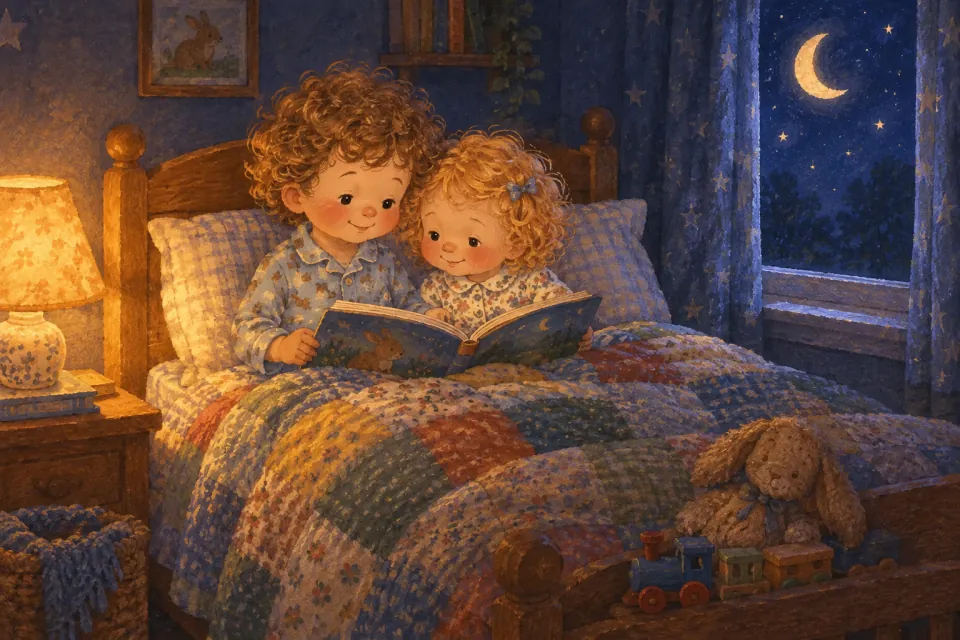
The best time to practice “I’m mad!” is when nobody is. At bedtime your child is calm, close, and happy to hear a story again. A story where a character their size gets mad, says so, gets help, and ends up fine gives them the whole sequence to copy.
Here’s a short one starring two made-up kids, Pip (3) and his sister Wren (2):
An example story
Pip’s Big Mad
Paper Diorama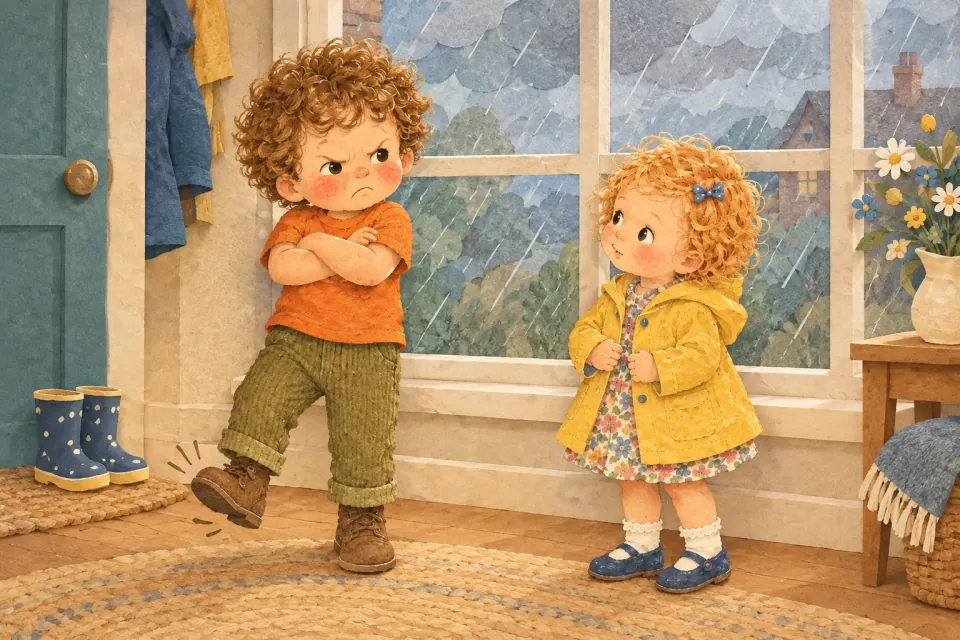
Rain, rain, rain. No park today. Pip’s face got hot. Stomp! Stomp! His mad was SO big. Wren watched with big eyes.
Pip took a breath. “I feel MAD!” he said. “I wanted the park!” Mama knelt down. “You’re mad. You wanted the park. I’m right here.” Together they blew the mad away. Whoooo. Whoooo.
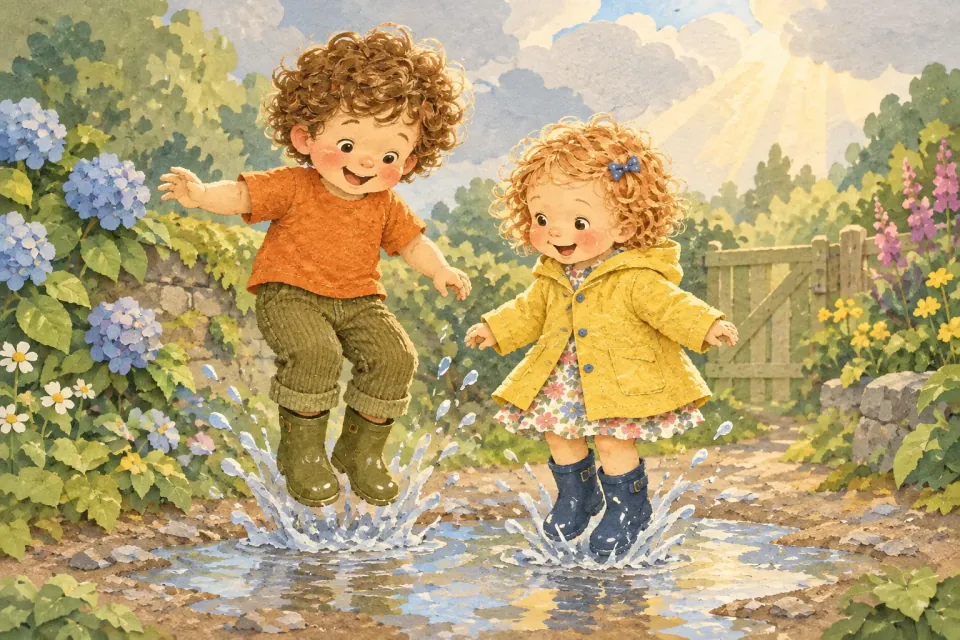
Then Mama found the boots. Splish! Splash! SPLOOSH! “I feel happy!” said Pip. “Me too!” said Wren. Some days are rainy. Some feelings are big. And big feelings can get smaller.
Pip names the feeling himself (“I feel MAD!”), a grown-up names it back and stays close, the calming step is something a child can do (blowing it out), and the ending shows the feeling changing. After reading, you might ask, “What did Pip say when he was mad?” and let your child shout it. Once Upon Us can write a story like this around your own kids and a real day from your photos, with using words for big feelings as the lesson, and it reads itself aloud at bedtime. For more ideas on wind-down time, see our toddler bedtime routine guide.
When to talk to your pediatrician
Most tantrums are ordinary tantrums. The AAP’s advice is to talk with your pediatrician if you’re concerned about your child’s tantrums or behavior (HealthyChildren.org). For aggression specifically, the AAP adds warning signs like injuries to themselves or others, attacks on adults, or aggression that lasts more than a few weeks and feels unmanageable (HealthyChildren.org). It’s also worth raising if you’re worried about your child’s talking or understanding. The CDC’s free milestone checklists can help you bring specifics to the appointment (CDC).
Questions parents ask
At what age do toddler tantrums stop?
There’s no set date, but the AAP notes that tantrums are most common between ages 1 and 3 and tend to get better after 3, as children gain words and self-control.
Should I ignore a tantrum?
You can stay calm and let the storm pass while staying close, then comfort your child once it’s over. The AAP is clear about one exception: don’t ignore hitting, kicking, biting or throwing.
What feelings words should I teach a 2-year-old first?
Start with a handful you can show on your face and in your voice: happy, sad, mad, scared and tired. Add frustrated, disappointed and excited as your child’s vocabulary grows. Use them about yourself too, not only about your child.
Do books about feelings really help toddlers?
They give you both shared words and pictures to point at when things are calm. ZERO TO THREE suggests reading feelings books side by side and talking about the characters’ faces, and one small 2023 study found that picture books can help three-year-olds pick up a calming strategy.
Sources
- Top Tips for Surviving Tantrums, HealthyChildren.org (American Academy of Pediatrics)
- 10 Tips to Prevent Aggressive Behavior in Young Children, HealthyChildren.org (American Academy of Pediatrics)
- Toddler Tantrums 101: Why They Happen and What You Can Do, ZERO TO THREE
- Toddler Tantrums and Meltdowns, ZERO TO THREE
- Your Calm Is Their Calm: Co-Regulation Strategies for Infants and Toddlers, ZERO TO THREE
- Milestones by 2 years, 30 months, 3 years and 4 years, CDC Learn the Signs. Act Early.
- The effect of picture book reading on young children’s use of an emotion regulation strategy, Schoppmann, Severin, Schneider and Seehagen, PLOS One (2023)