
A toddler bedtime routine that actually ends in sleep
A toddler bedtime routine for ages 2 to 4: which steps, in what order, how long it takes, what to say when they stall, and why the book goes last.

In this post
A toddler bedtime routine works when it’s short, the same every night, and ends with something calm you do together. The AAP’s version fits on a sticky note: brush teeth, read a book, go to bed at the same time (HealthyChildren.org). Everything else is detail you can adjust for your child.
Here’s how to build one for a 2- or 3-year-old, what order the steps go in, what to say when they stall, and what to do when the routine keeps falling apart anyway.
Why the routine matters more than the details
In a large study, researchers surveyed more than 10,000 mothers of children from birth to almost 6, across 13 countries and regions. Children who had a consistent bedtime routine went to bed earlier, fell asleep faster, woke less at night and slept longer, according to their parents. The more nights a week the routine happened, the better the sleep (Mindell et al., Sleep, 2015). It’s a survey, so it shows an association rather than proof.
The authors couldn’t say which parts of the routine matter most. That’s useful to know. The bath is optional. The specific song doesn’t matter. What seems to matter is that it happens, in the same order, most nights.
ZERO TO THREE puts the why simply: when young children can predict what happens next, they feel more secure and more in control (ZERO TO THREE). A toddler who knows that pajamas come before teeth and books come before lights out has less to fight about.
How much sleep 2- to 4-year-olds need
The American Academy of Sleep Medicine recommends, per the CDC:
- Ages 1 to 2: 11 to 14 hours in 24 hours, naps included
- Ages 3 to 5: 10 to 13 hours in 24 hours, naps included
Start from wake-up time, subtract the nap, and count back. If your 2-year-old wakes at 6:30 and naps for two hours, the night stretch should be roughly 9 to 12 hours, so bedtime lands somewhere in the evening you can actually keep.
Then set it and hold it. The AAP’s advice is to pick a regular bedtime and stick to it rather than waiting for yawns and eye-rubbing, and it notes that putting a child down even 15 to 20 minutes earlier can make a big difference (HealthyChildren.org). A lot of bedtime battles are really overtired battles.
A bedtime routine that works for most toddlers
Aim for something you can finish in 20 to 30 minutes. ZERO TO THREE suggests starting to wind down about 30 minutes before bed with slower, quieter games like puzzles, blocks or coloring (ZERO TO THREE). This order puts the stimulating parts first and the quiet parts last:
- Last active play ends. A clear “last game” helps. The AAP recommends avoiding active play right before bed (HealthyChildren.org).
- Bath, if it’s a bath night. Not every night needs one.
- Pajamas. Let them choose between two pairs.
- Teeth. The “brush” in Brush, Book, Bed.
- Last potty and last drink. Handle needs before lights out so they don’t become reasons to call you back. The AAP lists water, lights and the door as things to sort out ahead of time (HealthyChildren.org).
- Books. Two is a good number. The “book.”
- Song or cuddle. The same one every night.
- Lights out, with the same goodnight words. The “bed.”
For many kids, a comfort object helps too. The AAP suggests letting your child take a favorite thing to bed each night, like a stuffed animal or blanket, as long as it’s safe for their age (HealthyChildren.org).
A bedtime routine for a 2-year-old
Two-year-olds do best with fewer steps and more doing than talking. You lead, they follow, and each step has something physical in it: pick the pajamas, hold the toothbrush, turn off the big light. Transitions are hard at this age, so give a warning before each one (“Two more splashes, then out”).
Choices help, but keep them to two. “Duck pajamas or star pajamas?” works. “What do you want to wear?” invites a debate.
A bedtime routine for a 3-year-old
Three-year-olds can follow a picture chart of the steps and like checking them off. They also stall with real creativity. This is the age where you’ll hear about a sudden thirst, a sock that feels wrong and an urgent question about sharks. Give them a job they own (choosing the books, turning off the lamp, tucking in a stuffed animal) and a clear end point.
When they stall: “one more” and other classics
ZERO TO THREE calls this out directly: many young children use stalling tactics to delay bedtime, asking for snacks, water and just one more book. The advice is to remind them of the routine matter-of-factly and stick to it (ZERO TO THREE). It also helps to name the feeling before the limit, because going from playing to sleeping really is hard (ZERO TO THREE). Decide the limits in daylight, say them the same way every night, and keep your voice boring.
If you promise a check-in, do it, keep it short, and don’t restart the routine.
If they keep coming out of the room
Walk them back calmly with as few words as possible. For children around 3 and up, one tool with some evidence behind it is the bedtime pass: a card your child can trade for one trip out of the room after lights out, for a hug or a drink. Once it’s used, it’s used. In a small 1999 study with two boys aged 3 and 10, crying and coming out of the room dropped to zero, and parents rated the pass as more acceptable than either ignoring or letting the child sleep in the parents’ bed (Friman et al., 1999). Two children is a tiny study, so treat it as an idea worth trying rather than a guarantee.
When a child calls out after lights out and you know they’re safe and well, the AAP’s view is that you don’t need to go in while they work out how to settle themselves (HealthyChildren.org). Families differ a lot on this, and a child who is scared or unwell is a different situation. What helps in every version is responding the same way each time.
Make the story the anchor
Books usually go last, and for good reason. HealthyChildren.org suggests 10 to 20 minutes of book sharing, TV off, as part of the regular bedtime routine for 2- and 3-year-olds (HealthyChildren.org). Reading is quiet, it’s close, and it has an obvious ending. When the last book closes, everyone knows what comes next.
Let your child pick the books, and expect the same ones over and over. That’s normal and good. ZERO TO THREE notes that hearing a story again and again helps toddlers learn the sound, meaning, rhythm and tone of words (ZERO TO THREE). Some families keep one goodnight book that is always last, which turns it into a signal for sleep.
Stories about the routine itself are especially useful. Toddlers like seeing a character do exactly what they’re about to do, in the same order. Here’s the kind of thing we mean:
An example story
Goodnight, Everybody
Cozy Pencil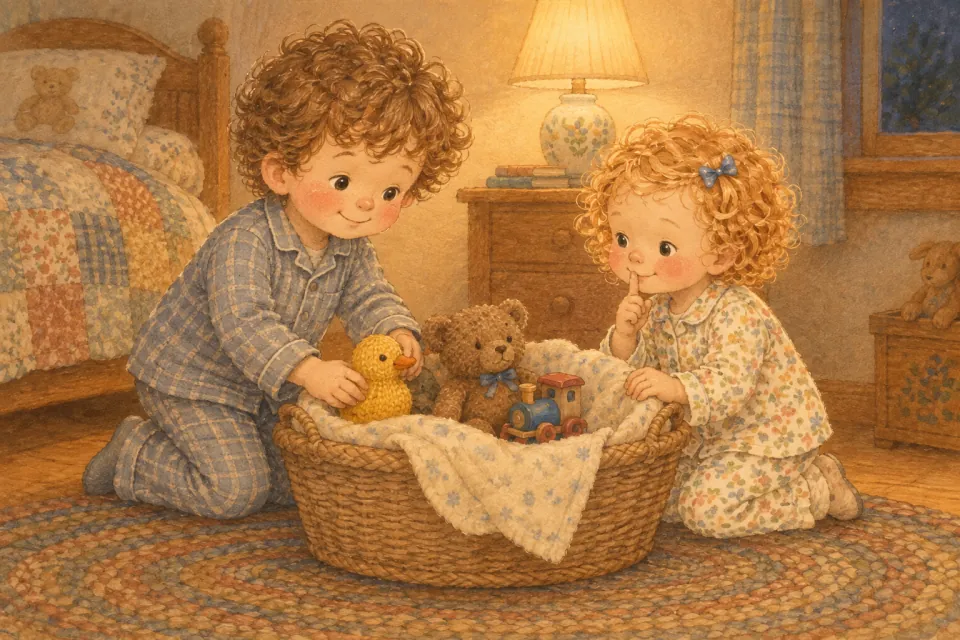
Pajamas on. Teeth brushed. Two books picked, one for Pip and one for Wren.
“Now everybody goes to bed,” said Pip.
Duck went in the basket. Goodnight, Duck. Bear went in the basket. Goodnight, Bear. The little wooden train chugged in last. Choo… choo… goodnight, train.
Wren yawned a great big yawn. The lamp glowed low. “Goodnight, everybody,” she whispered. Shh.
It follows the real order of the evening, it repeats one phrase your child can say along with you (“Goodnight, ___”), and it gets quieter as it goes. The toys go to bed first, so the child in the story isn’t the only one being asked to stop. If you want more like it, we wrote three short bedtime stories for 2- and 3-year-olds you can read tonight.
Light, screens and the room
The AAP recommends turning off all screens at least an hour before bedtime and keeping TVs, tablets and phones out of children’s bedrooms at night (HealthyChildren.org). Screens can make it harder to fall asleep in two ways: exciting content keeps kids wound up, and the light itself can interfere with melatonin, the hormone that helps us feel sleepy (AAP). ZERO TO THREE adds that watching TV together doesn’t usually work well as a bedtime routine, because the point of the routine is to help children relax (ZERO TO THREE).
We make a read-aloud picture book app, so we’d rather say this plainly than bury it. For young children the AAP puts print books first: its experts say touchscreens don’t offer the same interactivity and relationship-building as turning the pages of a book together, and that when digital books are used, the back-and-forth between parent and child should come along with them (HealthyChildren.org). If a read-aloud app is part of your book step, ours included, sit with your child and talk about the pictures, keep it early in the book step, and finish with a print book, a song or quiet talk in the dark. Once Upon Us dims a little with every page and stops after the number of stories you set, which helps. It’s still a screen.
For the room itself: dark, fairly quiet, toys put away or covered, and if your child wants a nightlight, a dim one. ZERO TO THREE suggests a nightlight, a hallway light with the door open or a dimmer for children who are scared of the dark (ZERO TO THREE).
When bedtime keeps falling apart
Even a good routine wobbles. A few common reasons:
- Bedtime drifted too late. Overtired toddlers fight harder. Try moving it earlier by 15 to 20 minutes for a week.
- Nap changes. Dropping or shortening a nap shifts the whole evening.
- Something big changed. A move, a new childcare setup or a new baby in the house can upend sleep for a while. Keep the routine as steady as you can and add some extra one-on-one time earlier in the day.
- Big feelings at the end of a long day. Meltdowns at bedtime are common. Our post on toddler big feelings has words that help in the moment.
- Potty training. A new skill can mean more trips and more stalling for a few weeks. Build the last potty into the routine, before books. (More in our guide to potty training books.)
Give any change about a week before you judge it. Toddlers test a new rule hardest right after you introduce it.
When to talk to your pediatrician
Mention it at a visit if bedtime is a nightly struggle for weeks despite a steady routine, or if your child wakes often at night and is tired during the day. HealthyChildren.org lists frequent snoring, problems breathing during the night, daytime sleepiness, trouble paying attention and behavior problems as possible signs of sleep apnea, and says to let your pediatrician know right away if you notice them (HealthyChildren.org).
Questions parents ask
What time should a 2-year-old go to bed?
There’s no single right clock time. Toddlers need 11 to 14 hours of sleep in 24 hours, naps included, so count back from when your child wakes up, subtract the nap, and pick a bedtime you can keep every night. The AAP notes that moving bedtime even 15 to 20 minutes earlier can make a big difference for a tired child.
How long should a toddler bedtime routine take?
Short enough to do every night, including the hard ones. Twenty to thirty minutes from pajamas to lights out works for many families, with 10 to 20 minutes of that for books, which is what HealthyChildren.org suggests for book sharing at this age.
What do I do when my toddler keeps getting out of bed?
Walk them back calmly, with as few words as possible, every time. For children around 3 and up, a bedtime pass (one card that buys one trip out of the room) is a simple option that did well in a small study.
Is it OK to read the same bedtime book every night?
Yes. Toddlers learn through repetition, and ZERO TO THREE notes that hearing a story again and again helps them with the sound, rhythm and meaning of words. A familiar last book also works as a signal that sleep comes next.
Should toddlers have screens before bed?
The AAP recommends turning screens off at least an hour before bedtime and keeping them out of children’s bedrooms at night. Print books and your voice are the default for the last part of the routine.
Sources
- Brush, Book, Bed: How to Structure Your Child’s Nighttime Routine, HealthyChildren.org (American Academy of Pediatrics)
- Toddler Bedtime Trouble: 7 Tips for Parents, HealthyChildren.org (American Academy of Pediatrics)
- Healthy Sleep Habits: How Many Hours Does Your Child Need?, HealthyChildren.org (American Academy of Pediatrics)
- About Sleep, Centers for Disease Control and Prevention
- Screen Time Affecting Sleep, American Academy of Pediatrics
- How to Share Books with Children 2 and 3 Years Old, HealthyChildren.org (American Academy of Pediatrics)
- Beyond Literacy: Shared Reading Starting at Birth Offers Lifelong Benefits, HealthyChildren.org (American Academy of Pediatrics)
- Sleep Challenges: Why It Happens, What to Do, ZERO TO THREE
- Sleep Struggles? We’ve Got Resources, ZERO TO THREE
- From Baby to Big Kid: Month 32, ZERO TO THREE
- Supporting Language and Literacy Skills from 12–24 Months, ZERO TO THREE
- Bedtime Routines for Young Children: A Dose-Dependent Association with Sleep Outcomes, Mindell et al., Sleep (2015)
- The Bedtime Pass: An Approach to Bedtime Crying and Leaving the Room, Friman et al., Archives of Pediatrics and Adolescent Medicine (1999)
- Sleep Apnea in Children: Detection & Treatment, HealthyChildren.org (American Academy of Pediatrics)