
Three short bedtime stories for 2- and 3-year-olds
Three original bedtime stories for toddlers, each about two minutes read aloud, plus what makes a good bedtime story for a 2- or 3-year-old and how to read it.
In this post
These are three short, original bedtime stories written for 2- and 3-year-olds. Each takes about two minutes to read aloud. They use short sentences, a phrase that repeats, something for your child to do, and an ending that gets quieter until someone falls asleep.
They star Pip, who is 3, and his sister Wren, who is 2. Pip and Wren are made up, so swap in your own child’s name, a sibling or a favorite stuffed animal. After the stories there’s a short section on what makes a bedtime story work for toddlers and how to read one aloud.
1. Where Does Everybody Sleep?
A gentle look around the garden at dusk, with a question your child can ask along with Wren.
A bedtime story to read tonight
Where Does Everybody Sleep?
Hedgerow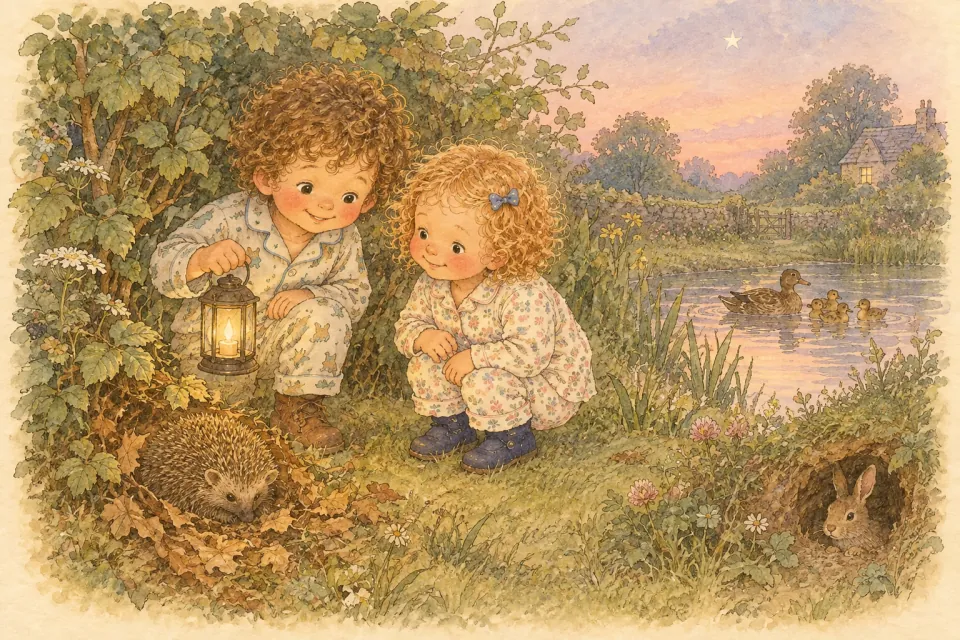
The sun was going down over the garden. Pip held the lantern. Wren held Pip’s hand.
“Where does everybody sleep?” asked Wren.
Down by the pond, Mother Duck tucked her ducklings under her wing. Quack, quack… quiet. “The ducks sleep on the pond,” said Pip.
By the old stone wall, a rabbit gave one last hop, right into her burrow. “The rabbit sleeps under the ground,” said Wren.
Then, under the hedge, something rustled. A little hedgehog was pushing leaves into a pile. Push, push, pat. She turned around three times and curled up into a round, prickly ball.
“The hedgehog sleeps in the leaves,” whispered Pip.
The first star came out. The breeze went hush.
“Where do we sleep?” asked Wren, with a very big yawn.
Pip smiled. “In our beds.”
So home they went. Up the path, in the door, and into their beds. Ducks on the pond. Rabbit in the ground. Hedgehog in the leaves. And Pip and Wren, snug and warm, fast asleep.
Your child can answer the question each time: “on the pond,” “under the ground,” “in the leaves.” By the end they know the pattern, and the last answer is theirs.
2. Button Can’t Sleep
A story about putting someone else to bed, which is often easier for a toddler than being put to bed.
A bedtime story to read tonight
Button Can’t Sleep
Felt & Wool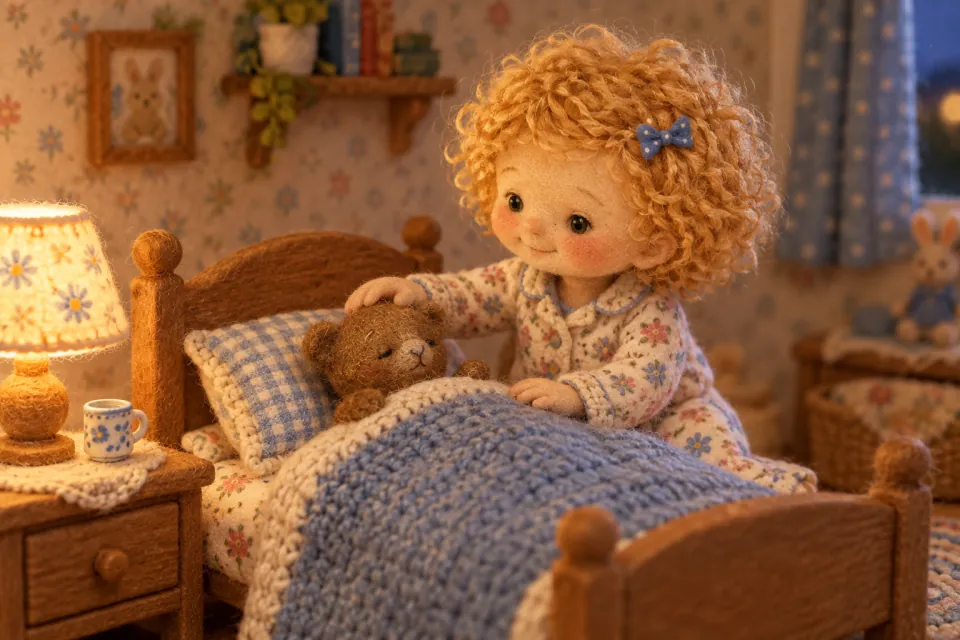
It was bedtime, but Button the bear could not sleep.
“Button is wiggly,” said Wren.
So Wren did what grown-ups do.
She gave Button a tiny sip of water. Sip.
She sang Button a tiny song. La, la, loo.
She tucked his blanket up to his chin. Tuck, tuck.
Then she gave him three soft pats. Pat, pat, pat. “Sleepy bear,” she said.
Button’s eyes stayed open.
Wren thought hard. What else do sleepy bears need?
“Oh,” she said. “You need a cuddle.”
She lay down next to Button and put her arm around him. The lamp was low. The house was quiet. Pat, pat, pat. “Sleepy bear,” she whispered.
Button yawned a tiny yawn. Wren yawned a big one.
Button’s eyes closed. And Wren’s eyes closed too.
When Mama peeked in, there were two sleepy bears in one little bed.
Pat your child’s back three times on “pat, pat, pat.” Your child may start doing the pats too, on you or on their own stuffed animal.
3. The Night Train
A counting story that slows down as it goes, for kids who love trains.
A bedtime story to read tonight
The Night Train
Moonlit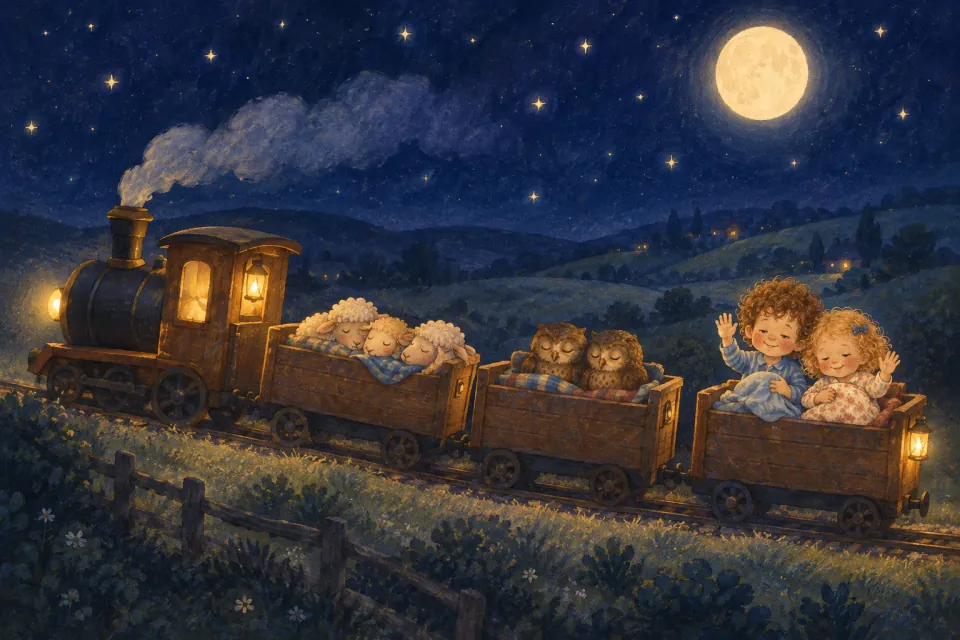
Chuff… chuff… chuff. Here comes the night train, slow and low over the hills.
At the first stop, three sleepy sheep climbed aboard. Baa, baa, yawn. They snuggled under a blanket.
At the next stop, two sleepy owls fluttered on. Hoo, hoo, yawn. They tucked their heads under their wings.
At the last stop, two sleepy children climbed on in their pajamas. Pip and Wren. They waved to one big moon. The moon glowed back.
Chuff… chuff… The train went slower. Over the hill. Past the pond. Round the bend.
“Goodnight, sheep,” whispered Wren. Three sheep, fast asleep.
“Goodnight, owls,” whispered Pip. Two owls, fast asleep.
The train went slower… and slower… and stopped.
Last stop: bed.
And the two sleepy children? Shh. Fast asleep.
Read the “chuff… chuff” slower each time, and let your voice drop to a whisper by the last stop. Toddlers match your pace more than you’d think.
What makes a good bedtime story for a toddler
Most picture books aren’t written for the last five minutes of the day. A few things make the difference.
The first is repetition. A phrase that comes back (“Where does everybody sleep?”, “Pat, pat, pat”) gives a toddler something to hold on to and, eventually, something to say. ZERO TO THREE notes that hearing a story over and over helps toddlers learn the sound, meaning, rhythm and tone of words, and that young children need to hear a story many times to fully understand it (ZERO TO THREE).
Keep the world small and familiar: gardens, beds, trains, stuffed animals. Toddlers are still sorting out their own day, and a bedtime story that stays close to it is easier to follow and less likely to wind them up.
Give your child something to do, like answering the question, counting the sheep or doing the pats. ZERO TO THREE points out that it’s perfectly normal for toddlers not to sit still for long, and suggests stories with repeated phrases and books that invite participation to help hold their attention (ZERO TO THREE).
Let the ending get quieter. Good bedtime stories start with a little energy and wind down, with shorter sentences near the end and characters settling one by one. Someone falls asleep, and the child in the story is last. That arc does some of the work of your bedtime routine for you.
And keep it short. Two or three minutes is plenty. You can always read it again, and they will ask.
How to read bedtime stories aloud
Reading belongs in the routine itself. The AAP and Reach Out and Read built a program around exactly that, called Brush, Book, Bed: brush teeth, read a book, go to bed at a regular time (Reach Out and Read, HealthyChildren.org). HealthyChildren.org suggests setting aside 10 to 20 minutes with the TV off for sharing books as part of your regular bedtime routine with 2- and 3-year-olds (HealthyChildren.org). A few things that help:
- Slow down on every page. Pause before the repeated line and let your child fill it in.
- Get quieter as you go. Normal voice for the first page, softer in the middle, a whisper at the end.
- Talk about the pictures. Point at the hedgehog. Ask where the owls are. The AAP’s advice is to respond with enthusiasm to your child’s questions and comments (HealthyChildren.org).
- Read the same one again. When the book closes and they say “again!”, that’s a good sign. Decide ahead of time how many readings you’ll do tonight.
- Let them move a little. A toddler holding a stuffed animal or doing the pats is still listening.
For 2-year-olds
Let them choose the book, even if it’s the same one as last night. Keep it to one short story or a few pages of a longer one. Name things in the pictures and repeat their words back with a little more added: “Duck! Yes, a sleepy duck on the pond.” HealthyChildren.org suggests enjoying the same book over and over and expanding on your child’s words (HealthyChildren.org).
For 3-year-olds
Three-year-olds can start to tell the story back to you. Ask them to tell you about the pictures, try “Can you find the moon?”, or stop before the last line and let them finish it. HealthyChildren.org suggests having 3-year-olds retell familiar stories in their own words and pointing out colors, shapes and numbers (HealthyChildren.org).
Why we put the child in the story
When the kid in the story has your child’s name, their stuffed rabbit or their big sister, the story becomes theirs. That’s the idea behind Once Upon Us: it turns photos from a day you loved into a picture book starring your own kids, reads it aloud, and answers when they shout “again!”. You don’t need an app for the core of it, though. Say your child’s name where it says Pip, and these stories are already theirs.
If there’s a particular skill you’re working on, a story can help rehearse it too. We’ve written about using social stories for toddlers to prepare for new things, and about potty training books that make the whole business less mysterious.
On screens: the AAP puts print books first for young children, because its experts say touchscreens don’t offer the same interactivity and relationship-building as turning real pages together (HealthyChildren.org). These stories work fine printed out or told from memory in the dark.
Questions parents ask
How long should a bedtime story be for a 2-year-old?
Short. A story that takes two or three minutes to read aloud is plenty for most 2-year-olds, and it’s normal for a toddler to manage only a few pages at a time. You can always read it twice.
What makes a good bedtime story for a toddler?
A small, familiar world, short sentences, a phrase that repeats, something for the child to do (say the refrain, count, pat), and an ending that gets quieter and finishes with someone going to sleep.
Why does my toddler want the same story every night?
Because repetition is how toddlers learn. ZERO TO THREE notes that hearing a story again and again helps them with the sound, meaning, rhythm and tone of words, and knowing what comes next is comforting.
Can I put my child’s name in these stories?
Yes, please do. We wrote them with made-up kids so you can swap in your own child’s name, a sibling, a pet or a favorite stuffed animal.
Sources
- How to Share Books with Children 2 and 3 Years Old, HealthyChildren.org (American Academy of Pediatrics)
- Beyond Literacy: Shared Reading Starting at Birth Offers Lifelong Benefits, HealthyChildren.org (American Academy of Pediatrics)
- Brush, Book, Bed: How to Structure Your Child’s Nighttime Routine, HealthyChildren.org (American Academy of Pediatrics)
- Brush, Book, Bed: The Best Bedtime Routine, Reach Out and Read
- Supporting Language and Literacy Skills from 12–24 Months, ZERO TO THREE
- Does My Toddler Have a Short Attention Span Because She Won’t Sit Still for a Story?, ZERO TO THREE