
The best potty training books for toddlers, and how to use them
Eleven potty training books toddlers ask for again and again, sorted by what each one is good for, plus when to start reading them and how to avoid pressure.
In this post
The best potty training books are short, matter-of-fact and a little funny, and they work best when you start reading them a few weeks before you start training. The AAP recommends reading children’s books about using the toilet to help the process make sense and seem inviting and exciting (HealthyChildren.org). A book can do something your reminders can’t: show your child every step, in order, happening to someone else first.
Below are eleven books worth knowing, grouped by what they’re good for, followed by how to use them before and during training, what to skip, and when to check in with your pediatrician.
How to choose a potty book for your child
There isn’t one best potty training book. There’s the one your child asks for. A few things help you pick:
- Age. Two-year-olds do best with board books, flaps and very few words. Three-year-olds can follow a picture book with a plot and a joke.
- Temperament. A child who resists will often go for a funny book about someone else resisting. An anxious child usually does better with calm, matter-of-fact facts.
- The words your family uses. The AAP suggests choosing positive words your family will use for body parts, pee and poop (HealthyChildren.org). Books vary a lot here, from anatomical terms to “potty” and “wee-wee.” Preview before you read it aloud, and swap words as you go if you like.
- What trips your child up. Some books focus on noticing the feeling, some on leaving play, some on accidents, some on using a bathroom away from home. Pick the one that matches the sticking point.
The best potty training books
For young toddlers: board books and flaps
Potty by Leslie Patricelli. A board book in which Baby debates whether to use the potty, with a lot of physical comedy and a big “I did it!” at the end. Few words, bold pictures, and the inner debate gives kids something to shout along with (Apple Books). A good first potty book.
P Is for Potty! by Naomi Kleinberg, illustrated by Christopher Moroney. A Sesame Street lift-the-flap board book in which Elmo explains how to use the potty. The publisher describes it as being for ages 1 to 3, with more than 30 sturdy flaps, and suggests it for while children practice sitting on the potty (Penguin Random House). Flaps buy you time on the seat.
A Potty for Me! by Karen Katz. A lift-the-flap book told from the child’s point of view. The child isn’t ready at first and would rather play, has an accident, tries a few times without luck, and finally cheers, “Yeah! I really did it!” (Publishers Weekly). Her mother stays encouraging throughout (Bookroo). Because the accident is just part of the story, it’s especially useful once training has started.
Where’s the Poop? by Julie Markes, illustrated by Susan Kathleen Hartung. A lift-the-flap book showing that animals each have a place to poop, from tigers in the jungle to monkeys in the rain forest, and that children have one too (Children’s Book World). Gentle and good for kids who like finding things.
Diapers Are Not Forever by Elizabeth Verdick, illustrated by Marieka Heinlen. A board book from the Best Behavior series that walks through why and how to use the potty in simple words: go, wipe, flush, wash your hands. The tone is encouraging rather than pushy, and there are tips for parents in the back (Elizabeth Verdick).
Daniel Goes to the Potty by Maggie Testa, illustrated by Jason Fruchter. A Daniel Tiger’s Neighborhood board book with the show’s little potty song (“When you have to go potty, stop and go right away. Flush and wash and be on your way!”) and a button that plays a flushing sound, so the noise gets familiar before it’s real (Daniel Tiger’s Neighborhood Archive). Great for Daniel fans, and the song is handy for kids who don’t want to stop playing.
For 3-year-olds and picture-book fans
Once Upon a Potty by Alona Frankel. The classic, first published in Hebrew in 1975 and in English in 1980, with separate editions for boys (Joshua) and girls (Prudence). It walks through the parts of a toddler’s body in plain, child-friendly terms, then follows the child learning to use a new potty (Wikipedia). It’s frank about bodies, so preview it to see whether its words suit your family.
Time to Pee! by Mo Willems. A crew of mice with signs guides the reader through every step: noticing you need to go, leaving your toys, peeing, washing your hands, and coming back to find your toys right where you left them (Goodreads). That last part answers a real toddler worry. The book comes with a success chart and stickers, which you can use or skip (Wikipedia).
Dinosaur vs. the Potty by Bob Shea. Dinosaur takes on lemonade, a sprinkler, puddles and a three-juice-box lunch, declaring victory each time without needing the potty, until his victory dance turns into a potty dance. Big, simple pictures and loud, funny text (Kirkus Reviews). A gentle mirror for kids who hold it because they don’t want to stop playing.
Everyone Poops by Taro Gomi. A matter-of-fact picture book about how every animal eats, so every animal poops, including people. It was written to take the shame and embarrassment out of the subject (Kane Miller, Wikipedia). Good for kids who are nervous about pooping.
I Want My Potty! by Tony Ross. The first Little Princess book. The princess hates nappies, thinks the royal potty is even worse at first, and soon learns to love it, even if it isn’t always where she needs it. British humor and a palace full of people rushing to help (BookTrust, Goodreads).
When to start reading potty books
Start before you start training. A few weeks of reading, with no expectations attached, lets your child get curious on their own terms.
For timing the training itself, the AAP says children usually show signs of bladder and bowel control between 18 and 24 months, that the average age to begin in the US is between 2 and 3, and that most children are bowel and bladder trained by 4 (HealthyChildren.org). Signs your child may be ready include:
- Staying dry for at least two hours during the day, or after naps
- Showing signs before peeing or pooping, like grunting, squatting or freezing
- Following simple instructions
- Walking to the bathroom and helping to undress
- Disliking wet diapers
- Asking to use the toilet, or asking for “big-kid” underwear (HealthyChildren.org)
The AAP also suggests waiting if your family is moving, expecting or recently welcomed a baby, or going through a major change (HealthyChildren.org). If a new sibling is on the way, our post on big sister and big brother books covers that transition.
How to use potty books before and during training
Before you start, read them like any other book, not as a lesson. Leave one next to the potty chair. The AAP suggests a child-sized potty chair where feet touch the floor, and books or toys can make sitting there more fun (HealthyChildren.org). Point out the steps in the pictures without asking your child to do them yet.
Once training starts, read the book that matches where your child is stuck. If they won’t leave their trains, read Time to Pee! or Dinosaur vs. the Potty. If they had an accident today, read A Potty for Me! A short routine helps too. The AAP suggests regular potty times, especially first thing in the morning (HealthyChildren.org), and a last potty before bed fits naturally into a toddler bedtime routine.
Expect accidents. The AAP notes that they can continue for months after training seems complete, even at 3 or 4 (HealthyChildren.org), and that children learn best when they’re praised for progress rather than punished for mistakes. When your child has an accident, say you’re sure they’ll do better next time and ask them to help you clean up (HealthyChildren.org).
When it goes well, make the praise specific. The AAP’s example is “I am so proud you are able to use the toilet so well” (HealthyChildren.org).
What to avoid
The AAP is direct about this. Children control when and where they pee and poop, so power struggles, begging, pleading, rewarding and punishing keep them from managing their own toileting (HealthyChildren.org). Its advice is to avoid treats and punishments, stay calm, and keep your child in charge of their own body (HealthyChildren.org).
Skip books that shame, tease or make a big show of failure, and don’t read potty books as a warning (“Remember what happened to Dinosaur?”). Watch for fears too. The AAP notes that some children worry the toilet will suck them in or take a part of them away, and suggests letting them control the flushing (HealthyChildren.org).
A potty story to read together
Here’s a short potty story in the style of the app, starring two made-up kids:
An example story
Pip Listens to His Body
Sunlit Gouache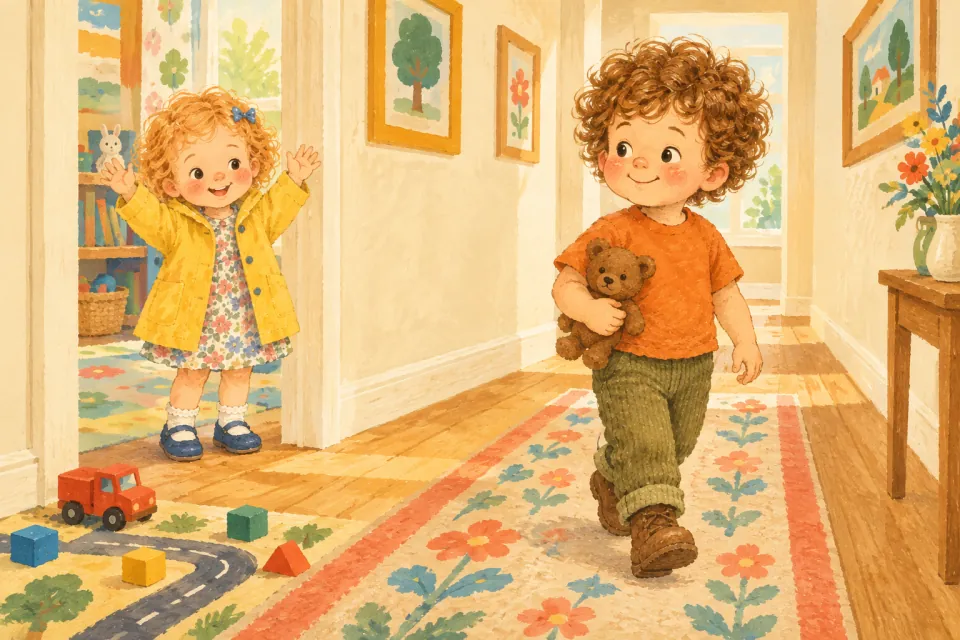
Pip was building a road for his red truck. Vroom, vroom! Then his tummy said, wiggle-wiggle.
Pip stopped. He listened. “My body says potty time.”
He left his truck right where it was. Down the hall he went, Bear under his arm. Step, step, step.
“Go, Pip, go!” called Wren.
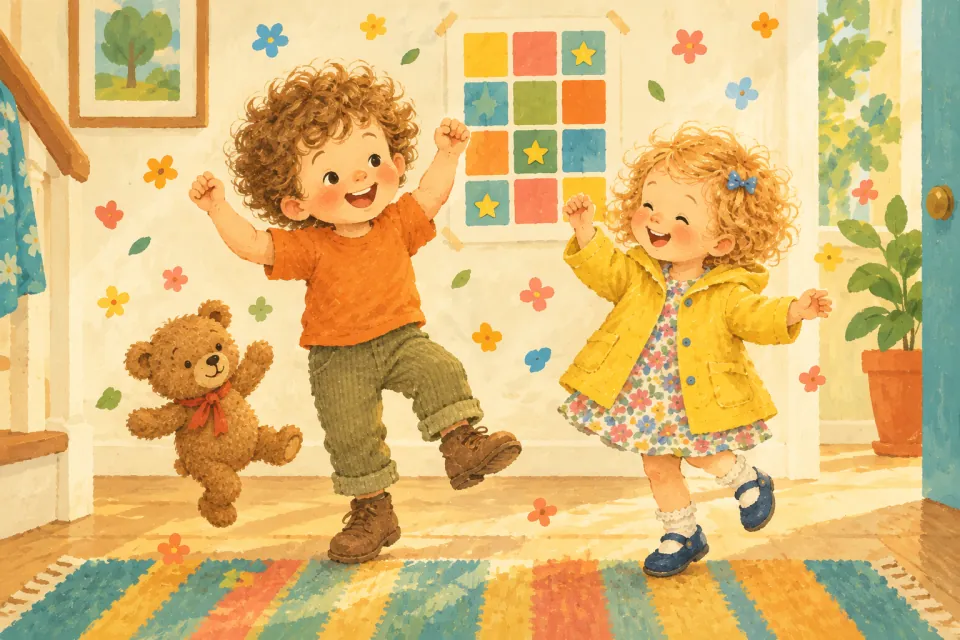
Pip went potty. Flush! Whoosh! He washed his hands, rub-a-dub, bubbles and all.
Then back down the hall to his truck, right where he left it. “I listened to my body,” said Pip.
And he did a happy dance. Wren danced too. Wiggle-wiggle, whoosh, hooray!
It shows the steps in order, gives your child a phrase to repeat (“My body says potty time”), treats leaving play as no big deal because the truck is still there, and ends on pride rather than a prize. You’ll also notice the pictures stay in the hallway. Our stories keep children out of bathroom scenes on purpose, and the story works fine without them. Potty time is one of the lessons Once Upon Us can weave into a book about your child’s own day.
Regression, and when to call your pediatrician
Plenty of children who seemed trained go backward for a while. The AAP lists common causes: a change in childcare, a new sibling or pregnancy, a major illness, a move, stress at home, and medical issues like constipation, painful bowel movements or a urinary tract infection. Because regression sometimes signals an infection or another problem that needs treatment, the AAP suggests checking with your pediatrician first. It also notes that regression usually doesn’t last long (HealthyChildren.org).
Talk to your pediatrician if your child has pain when peeing or pooping, seems constipated, or has frequent accidents at 3 that aren’t getting less frequent. The AAP notes that quite frequent accidents in a 3-year-old, especially when they aren’t diminishing, may signal a physical or developmental problem worth checking (HealthyChildren.org).
Big feelings can come with all of this. If potty time has turned into a daily standoff, our guide to toddler big feelings has words that help in the moment.
Questions parents ask
When should I start reading potty training books?
A few weeks before you plan to start, once you see signs of readiness. The AAP says children usually show signs of bladder and bowel control between 18 and 24 months, and the average age to begin toilet training in the US is between 2 and 3.
What’s the best potty training book for a 2-year-old?
A short board book with flaps or a funny, simple story, such as Potty by Leslie Patricelli, P Is for Potty! or A Potty for Me! by Karen Katz. Save longer picture books like Once Upon a Potty and Time to Pee! for when your child can follow a plot.
Are there potty training books for boys and girls?
Once Upon a Potty by Alona Frankel comes in separate editions for boys and girls. Most of the other books on this list work for any child.
Should we use a sticker chart?
The AAP’s main advice is specific praise and no punishment, and it cautions against treats. It does list stickers on a chart as one gentle way to encourage progress after a regression. If you use one, keep it low-key and never take stickers away.
What if my toddler is scared of the toilet?
It’s a common fear. The AAP notes that some children worry the toilet will suck them in, and suggests letting them control the flushing. A matter-of-fact book like Everyone Poops can also take some of the mystery out of it.
Sources
- The Right Age to Potty Train, HealthyChildren.org (American Academy of Pediatrics)
- Potty Training: 12 Tips to Keep the Process Positive, HealthyChildren.org (American Academy of Pediatrics)
- Potty Training Regression, HealthyChildren.org (American Academy of Pediatrics)
- Are Accidents Normal or the Sign of a Problem in the Toilet Training Process?, HealthyChildren.org (American Academy of Pediatrics)
- Everyone Poops, Kane Miller Books
- P Is for Potty! (Sesame Street), Penguin Random House
- Daniel Goes to the Potty, The Daniel Tiger’s Neighborhood Archive
- A Potty for Me!, Publishers Weekly
- Time to Pee!, Wikipedia
- Dinosaur vs. the Potty, Kirkus Reviews
- Once Upon a Potty, Wikipedia
- Diapers Are Not Forever (board book), Elizabeth Verdick
- I Want My Potty!, BookTrust
- I Want My Potty!, Goodreads
- Create a Potty Training Plan for Your Child, HealthyChildren.org (American Academy of Pediatrics)
- Potty, Apple Books
- A Potty for Me!, Bookroo
- Where’s the Poop?, Children’s Book World
- Time to Pee!, Goodreads
- Everyone Poops, Wikipedia