
How to teach a toddler to share (start with taking turns)
Sharing skills usually arrive around 3½ to 4. What to expect at 2, what to say during toy fights, how turns and timers help, and books about sharing.
In this post
If your 2-year-old won’t share, that’s on schedule. ZERO TO THREE points out that many parents expect sharing by age 2, when the skills develop between about 3½ and 4 years old (ZERO TO THREE). Until then, the thing to teach is taking turns. A turn has a clear start and a clear end, and a toddler can see both.
This guide covers why sharing is hard at this age, what to say when two children want the same toy, how to set up play so there are fewer fights, and how to practice turns in a story.
Why sharing is so hard for toddlers
Sharing asks a lot of a small brain. You have to imagine how the other child feels, trust that the toy will come back, and hold back the urge to grab it. Toddlers are still working on all three.
ZERO TO THREE notes that children under 2 are only beginning to understand that other people have their own thoughts and feelings, and that the part of the brain that controls impulses doesn’t really kick in until between ages 3 and 4 (ZERO TO THREE). So “Just give her a turn” is a big request of someone who can’t picture her face yet and can’t stop his own hand.
There’s also the matter of time. To a 2-year-old, “share” can sound like “give it away forever.” ZERO TO THREE warns that if children don’t get enough time with a toy before giving it up, they may come to see sharing as never getting to really play with anything (ZERO TO THREE). No wonder they hang on.
What to expect at 2, 3 and 4
- Around 2½, children play next to other children and sometimes with them (CDC). Two toddlers on one rug with one dump truck is a hard setup at this age.
- Around 3, children notice other kids and join them to play (CDC). The AAP notes that three-year-olds can start working out disputes by taking turns or trading toys, with a grown-up encouraging them to use words (HealthyChildren.org).
- Around 4, children ask to play with other kids and comfort friends who are upset (CDC). Sharing gets easier because they can finally imagine how the other child feels.
Why taking turns comes first
“Share” is abstract. “Your turn, then my turn” is concrete. A turn has an end, so the child giving something up knows it’s coming back, and the child waiting knows the wait will end.
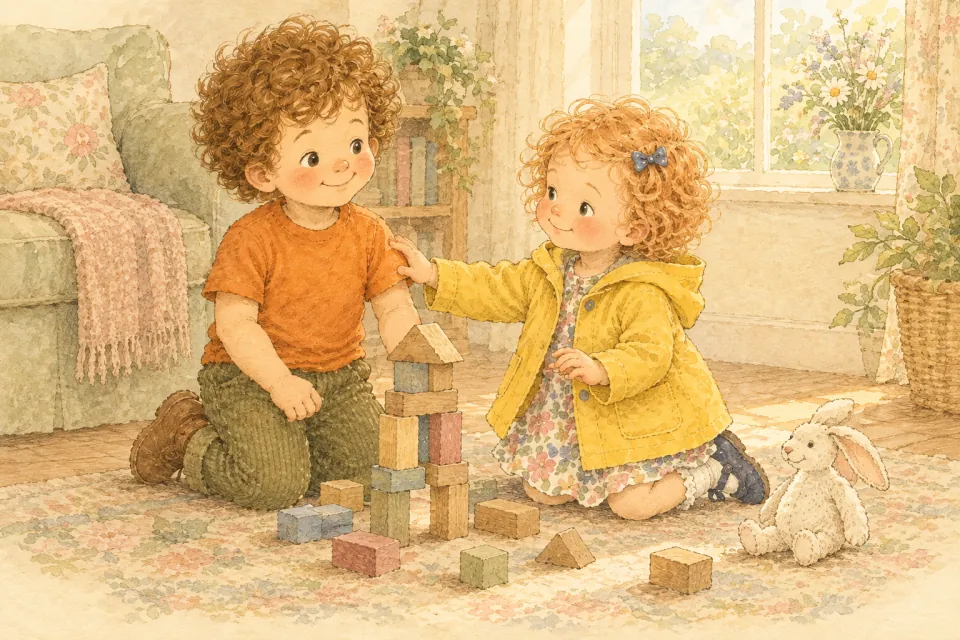
You can practice turns long before anyone fights over a toy. ZERO TO THREE suggests building it into ordinary play: your child puts a block on the tower, then you add one; you take turns at clean-up time; you take turns turning the pages of a book (ZERO TO THREE). Say it out loud each time, “My turn... your turn!”, so the words become familiar before they’re needed in a hard moment.
What to do when two toddlers want the same toy
1. Stop the grab and slow things down
Step in close and stop the grabbing or hitting in a calm, low voice. ZERO TO THREE suggests something as simple as “I can’t let you hit” or “No grabbing,” and then describing what’s happening so everyone slows down, like “Two children who both want the same trains!” (ZERO TO THREE).
If hands are already flying, our guide to gentle hands and toddler hitting has scripts for that part.
2. Protect the turn instead of forcing a handover
It’s tempting to take the toy and hand it over, but that teaches that whoever complains loudest wins it. Let the child who has it finish a reasonable turn. ZERO TO THREE recommends long turns, with the waiting child offered something else to do (ZERO TO THREE).
3. Let a timer be the referee
Young children don’t have a sense of time yet. ZERO TO THREE calls a timer “a helpful rule-keeper,” because the bell decides when the turn is over instead of a grown-up (ZERO TO THREE). A kitchen timer, a sand timer or a song all work.
4. Give them the words
The AAP suggests telling children to “use your words” to solve problems instead of acting out (HealthyChildren.org). Toddlers need you to supply the words first. Keep them short and say them the same way every time.
5. Point out the handoff
When a turn gets passed along, even with your help, notice it. ZERO TO THREE suggests commenting when children cooperate, like “I like how you gave Ellie the doll” (ZERO TO THREE). Point to the other child’s face: “You gave Wren a turn. Look how happy she is.”
Set up play so there’s less to fight about
A few changes to the room do a lot of the work.
- Put special toys away first. Before a friend comes over, let your child pick a few treasures that don’t have to be shared, and put them away (ZERO TO THREE).
- Double up. Put out several of the same kinds of toys so there’s enough for everyone: two shovels, two buckets, a pile of blocks (ZERO TO THREE).
- Choose side-by-side play. Art, water and sand let children play next to each other without much turn-taking (ZERO TO THREE).
- Watch the clock. Hungry, tired toddlers share worse. A snack before the playdate is worth it.
With siblings, the same toy fight can happen twenty times a day. It can help to give each child a small shelf of “mine” toys and treat everything else as turn-taking toys. If a new baby is part of the picture, see our guide to big sister and big brother books.
Books about sharing and taking turns
Picture books give you a shared language for this. A few that work for toddlers and preschoolers:
- Llama Llama Time to Share by Anna Dewdney. Llama Llama is not happy about sharing his toys when his new neighbor, Nelly Gnu, comes over to play (Penguin Random House).
- Sharing Time by Elizabeth Verdick, illustrated by Marieka Heinlen. A board book in Free Spirit’s Toddler Tools series that offers simple choices like taking turns, using a toy together, or waiting (Elizabeth Verdick).
- Should I Share My Ice Cream? by Mo Willems. Gerald the elephant debates sharing with Piggie for so long that his ice cream melts. Best for 3s and 4s.
- The Doorbell Rang by Pat Hutchins. The cookies have to be split again every time more friends arrive.
Practice turns in a story
A story lets your child watch someone their size wait for a turn and get it, without a real toy on the line. In a 2023 study, three-year-olds who were read a picture book, interactively, about a child who kept herself busy with toys while waiting used that strategy more in a later waiting task than children who read an unrelated book (the effect showed up once the researchers accounted for how much picture-book experience each child had) (Schoppmann et al., PLOS One). It’s one small study, but waiting is most of what taking turns is.
Here’s a short one starring two made-up kids, Pip (3) and his sister Wren (2):
An example story
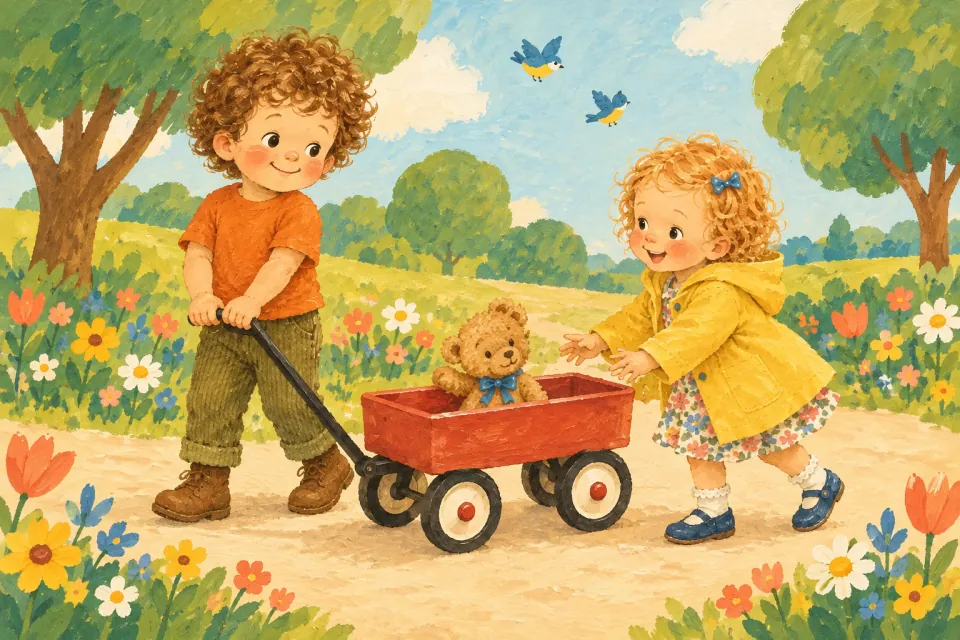
The Little Red Wagon
Sunlit Gouache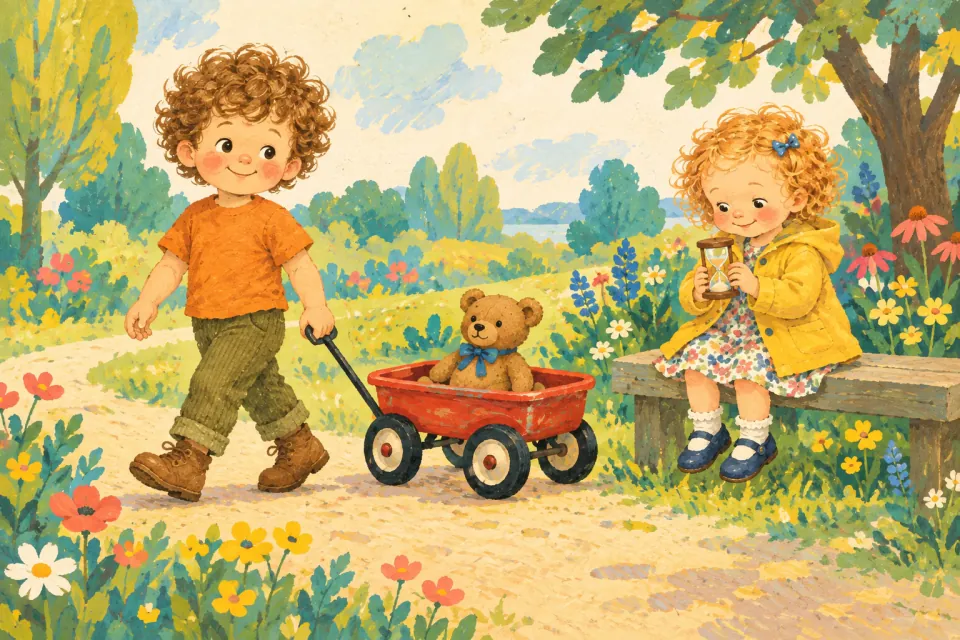
Pip had the red wagon. Rattle, rattle, round the path! “My turn!” said Wren. “Pip is using it,” said Grandma. She gave Wren the little sand timer. “When the sand runs out, it’s your turn.”
Wren watched the sand. Trickle, trickle. She counted the ducks. One, two, three.
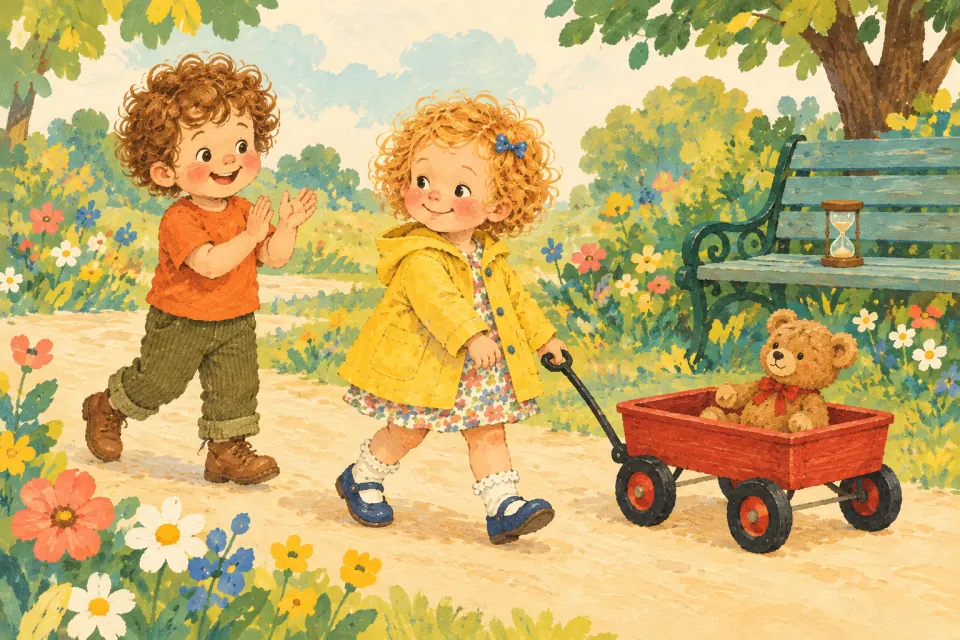
The sand ran out! Pip passed the handle. “Your turn, Wren!” Rattle, rattle, round she went, and Pip clapped all the way. My turn, your turn, round and round. The wagon had room for everyone.
The story shows waiting instead of saying “be patient.” The timer, not a grown-up, decides when the turn ends. Wren has something to do while she waits (the ducks), the turn comes when it was promised, and “my turn, your turn” gives your child a line to say at the park. Once Upon Us can write a story like this about your own kids and a real afternoon from your photos, with taking turns or sharing chosen as the lesson.
When to check in with your pediatrician
Struggling to share at 2 or 3 is normal and isn’t a reason to worry on its own. If your child isn’t showing interest in other children by around 3, or if grabbing turns into frequent hitting or biting that doesn’t ease over a few weeks, mention it at your next visit. The CDC’s milestone checklists are a simple way to bring specifics (CDC). And if the grabbing comes with big meltdowns, our guide to toddler big feelings and tantrums may help.
Questions parents ask
At what age should a child be able to share?
Later than most parents expect. ZERO TO THREE says sharing skills develop between about 3½ and 4 years old. Before that, taking turns with a lot of adult help is a realistic goal.
Should I make my toddler share when another child asks?
It usually works better to protect turns than to force an instant handover. Let your child finish a reasonable turn, tell the other child when their turn is coming, and help them find something to do while they wait.
Is it okay for my child to have toys they don’t have to share?
Yes. ZERO TO THREE suggests letting your child choose a few special toys to put away before a friend comes over, and putting out several of the same kinds of toys so there are enough for everyone.
How do I teach a 2-year-old to take turns?
Practice in easy moments first: take turns adding blocks to a tower or turning pages in a book, and say whose turn it is out loud. Keep turns short at first, and use a timer when two children want the same thing so the timer, not you, decides when the turn ends.
Sources
- Helping Young Children With Sharing, ZERO TO THREE
- Tuning In: Supporting Sharing, ZERO TO THREE
- Social Development in Preschoolers: Learning How to Share & Cooperate, HealthyChildren.org (American Academy of Pediatrics)
- Milestones by 30 months, 3 years and 4 years, CDC Learn the Signs. Act Early.
- The effect of picture book reading on young children’s use of an emotion regulation strategy, Schoppmann, Severin, Schneider and Seehagen, PLOS One (2023)
- Sharing Time, Elizabeth Verdick